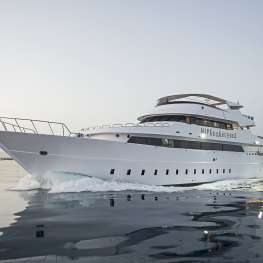
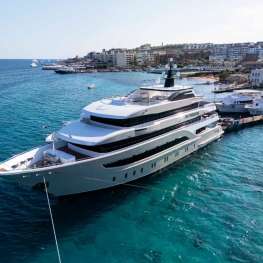
Hammerhead I is a 32-metre Egyptian Red Sea liveaboard for 20 guests in 10 ensuite, individually air-conditioned cabins: six lower-deck Standard Twins, two upper-deck Standard Twins and two upper-deck Master Suites with double beds. A 40 m² dive deck, two tenders, Nitrox production and routes from northern wrecks to Brothers, Daedalus, Elphinstone and the Deep South make it a focused choice for week-long diving safaris.
Description
Boat
M/Y Hammerhead I is a purpose-built Egyptian Red Sea safari vessel launched in the middle of the last decade and operated by Hammerhead Fleet since 2017. The operator publishes an overall length of 32 metres and the 2023 technical catalogue adds a 6.6-metre beam, 2-metre draft and 235-tonne gross tonnage. Some public specifications conflict: the current fleet page lists two 680 hp engines, while the catalogue and current retail pages say 600 hp; the operator also alternates between three and four decks. These figures should be confirmed for technical contracting rather than silently combined.
Guest spaces are arranged around a panoramic air-conditioned salon, a separate dining area and several open decks. The official catalogue measures the salon at about 40 m², the dining room at 30 m², the main sun deck at 40 m², the forward sun area at 15 m² and the high deck at 45 m². Sofas, shaded and open seating, loungers, a television and broad windows give divers different places to relax between dives. Published measurements are approximate and do not imply exclusive guest use at all times.
The working stern is designed for a full dive group. The operator describes a 40 m² dive deck with 21 individual gear positions, while its catalogue says the area can serve up to 24 people. Hammerhead I nevertheless carries a maximum of 20 guests in its confirmed guest cabins. Tank racks, benches, a central preparation aisle and a low aft platform keep equipment handling separate from the salon and restaurant.
Two 5.2-metre tenders with 40 hp Yamaha outboards are listed for reef entries and pickups, with a smaller emergency Zodiac also shown in the technical data. Two Bauer air compressors and a dedicated Nitrox compressor support the dive programme. Tender specifications, passenger limits and operating availability should still be checked on the departure date.
The present operator page lists two watermakers with total production of approximately six tonnes per day, an 8-tonne fresh-water tank figure and a 180-litre hot-water tank. The 2023 catalogue instead lists 16 m³ of fresh-water storage. Because the capacity figures differ, neither should be converted into a guest consumption promise. Fresh water is finite on any liveaboard, and guests should follow the crew's conservation instructions.
Safety equipment advertised for Hammerhead I includes an emergency first-response kit, oxygen, two 20-person liferafts, fire extinguishing and smoke-detection systems, radar, GPS, VHF radio and standard navigation equipment. These are supporting systems, not replacements for the onboard briefing, personal surface signalling devices, suitable insurance or the captain's decisions about weather and access.
Meals are normally served on a full-board basis. Current itemised booking pages include main meals, snacks, drinking water, soft drinks and tea/coffee, but menus and special-diet procedures are not fixed boat specifications. Dietary, allergy, religious or medical requirements should be submitted before payment and reconfirmed on the guest form. Alcohol and premium drinks should be treated as extras unless the quotation names them.
Hammerhead I is principally a scuba liveaboard. Hammerhead Fleet also markets kite-surfing, marine leisure and custom services, but those are separate programmes. A standard dive safari does not automatically include kite equipment, tuition or a leisure-cruise activity plan. Non-divers and snorkellers should obtain written confirmation of acceptance, supervision, activities and price for the selected week.
Cabin
The official inventory reconciles to 10 guest cabins, 20 berths and three clearly defined categories:
- 6 Lower Deck Standard Twin Cabins — maximum 2 guests each: approximately 8 m² according to the official catalogue, with two separate single beds. These rooms make up the largest share category and are the usual option for friends or paired solo guests.
- 2 Upper Deck Standard Twin Cabins — maximum 2 guests each: approximately 7 m², again with two separate single beds. Their upper position provides a different outlook and easier access to outdoor areas, but it does not add a balcony or a separate sitting room.
- 2 Upper Deck Master Suites — maximum 2 guests each: approximately 6 m² in the catalogue and equipped with one shared double bed according to the current category inventory. “Master Suite” identifies the double-bed category and deck position; it should not be advertised as a larger room, because the operator's own published area is actually smaller than the Standard rooms.
The arithmetic is exact: six lower twins + two upper twins + two upper double suites = 10 cabins and 20 guests. Crew, captain and dive-guide rooms shown elsewhere in the plans are operational accommodation and are not extra saleable guest cabins.
Every guest cabin is advertised with a private ensuite shower and toilet and individually controlled air conditioning. The operator also lists Egyptian-cotton bed linen and luggage storage. Official photographs confirm typical twin, double and bathroom arrangements, but they do not establish that every room has identical clearances, window sizes or storage configuration.
The cabin sizes should be described as operator-published approximations rather than surveyed measurements. Exact mattress dimensions, convertibility of twin beds, safe, hairdryer, minibar, USB outlets, bathrobes, toiletries by brand and cabin-by-cabin socket positions are not reliably published. These amenities must not be promised from generic reseller icons. Current retail packages do include complimentary toiletries and cabin towels, but the precise supply and replacement schedule can change.
The two upper Standard rooms remain twins; couples wanting a single shared mattress should request one of the two Master Suites. Conversely, the Master double is not suitable for two unrelated guests who require separate beds unless the operator confirms an alternative arrangement in writing. The reservation should identify category, deck, bed type, occupancy and any sole-use supplement.
Single occupancy is not a dedicated cabin type. Solo guests generally share a Standard Twin or request private use subject to availability and price. No accessible cabin, lift or step-free route is published. Stairs, raised thresholds, moving decks and tender transfers mean guests with limited mobility should request a written suitability assessment before booking.
Diving
Hammerhead I is equipped for recreational Red Sea liveaboard diving, with routes that can cover the northern wrecks, the Strait of Tiran, Brothers, Daedalus, Elphinstone, St John's, Fury Shoal, Rocky and Zabargad. The 2023 catalogue lists 24 twelve-litre cylinders, two Bauer compressors and a Nitrox compressor. The current operator page confirms Nitrox capability but does not make it universally free.
A normal seven-night safari contains six diving days and may offer around 18 dives when weather, transfers and the route permit. This is an indicative rhythm, not a guaranteed total. Boarding formalities, check dive, overnight navigation, marine-park restrictions and the pre-flight surface interval can reduce the number. The first and last diving days are commonly shorter.
Experience thresholds vary by itinerary and seller. Current programme information uses about 30 logged dives plus Open Water certification for northern and easier southern routes, around 20 dives plus Open Water for some “Southern Charm” programmes, and 50 logged dives plus Advanced Open Water or equivalent for Brothers–Daedalus–Elphinstone. The departure-specific requirement controls. A logbook number alone does not replace recent experience in current, wall diving, negative entries, wrecks and blue-water ascents.
The two tenders support entries and pickups when Hammerhead I cannot moor beside the site. Exposed marine parks can involve rapid descents, current, open-water safety stops and separation risk. Guests should follow the assigned team, carry the required SMB and signalling equipment, respect depth and gas limits, and understand the vessel's lost-diver procedure.
Night diving may be scheduled at suitable sheltered reefs, but it is not allowed inside certain Egyptian offshore marine parks. A package that lists night dives means they are included where legally and operationally possible, not that every evening produces a dive. Torch rental, backup light and night-diving qualification requirements should be checked before travel.
Standard packages commonly provide a 12-litre air cylinder, weights and guide service. Nitrox, 15-litre cylinders, complete or partial rental sets, private guides, courses and speciality training are booking variables. Nitrox users must hold the appropriate certification and analyse and label their own cylinder. Technical diving, rebreather support, decompression gases and sidemount are not confirmed as routine services.
Personal dive-accident insurance covering recompression, evacuation and repatriation is strongly advisable and may be required by the selected contract. A booking channel refers to short-term DAN cover on request, but that is not a safe substitute for reviewing personal coverage. Guests should bring certification cards, a recent logbook, any required medical clearance and the signed operator forms.
Possible marine life ranges from turtles, rays, dolphins and schooling reef fish to tuna, barracuda and seasonal pelagic sharks. Thresher, hammerhead, grey reef and oceanic whitetip sharks are associated with offshore routes, but sightings, visibility and current cannot be guaranteed. Sound buoyancy, no-touch wreck and coral practice, and conservative profiles take priority over wildlife photography.
Other Information
Commonly included when expressly stated in the booking confirmation:
- Accommodation in the booked shared cabin category for the stated cruise nights
- Full board with main meals, snacks, drinking water, soft drinks and tea/coffee
- The scheduled recreational diving package, guide service and night dives where permitted
- Standard 12-litre air cylinders, air fills, weights and weight belts
- Cabin and deck towels, routine toiletries and onboard Wi-Fi on current listings
- VAT on current itemised retail packages
- Short-term DAN cover on request on one sales channel, subject to its actual terms
Mandatory or commonly charged separately on current offers:
- Marine-park/environmental fee — currently displayed as approximately EUR 200 per trip on major retail listings
- Port fee — currently approximately EUR 45 per trip
- Service charge — currently approximately EUR 100 per trip
- A fuel surcharge is listed by one channel at approximately EUR 45 per trip, while another current itemisation omits it; obtain a single all-fees total
Normally excluded or optional unless the contract specifically includes them:
- International and domestic flights, baggage fees, hotel nights and independent travel
- Egyptian visa and passport-related expenses
- Airport, hotel and port transfers, including transfers between Hurghada and Port Ghalib
- Nitrox, Nitrox training, 15-litre cylinders, rental equipment, private guide and courses
- Alcohol, premium drinks and purchases from any onboard bar
- Laundry or pressing, land excursions, spa-style services and personal purchases
- Crew and guide gratuities
- Comprehensive travel, cancellation, medical and dive-accident insurance
Itineraries
Hammerhead I can be scheduled across Hammerhead Fleet's northern, central and southern Red Sea programmes. Standard safaris are usually eight days/seven nights with six diving days; the fleet also publishes an extended 15-day/14-night “Gigantic” expedition with 13 diving days. The following routes are original representative plans, not fixed daily contracts.
Weather, current, port authority instructions, marine-park rules and the captain's judgement determine the final order. A named reef can be replaced and a dive can be cancelled for safety. Around 18 dives is common on a normal week, while wildlife remains entirely unpredictable.
Exploring North — Wrecks, Ras Mohammed and Tiran
This northern circuit combines historic shipwrecks with coral reefs and current-swept walls. It is normally one of the more accessible Hammerhead I programmes, yet wreck penetration, strong current and crossings still demand sound buoyancy and recent experience.
Day 1 — Embarkation: meet the team in the confirmed Red Sea port, complete paperwork, settle into the allocated cabin, assemble equipment and attend safety and dive briefings. Sailing depends on clearance; an arrival-night dive is not promised.
Day 2 — Check dive and northern reefs: a protected reef is used to check weighting, equipment and buddy teams. Shaab El Erg, Gubal or a comparable site may follow, with dolphins possible but never guaranteed.
Day 3 — Abu Nuhas: suitable conditions may allow dives on selected wrecks such as Giannis D or Carnatic. Exterior touring is available to properly qualified divers; entering an overhead depends on training, guide approval and site conditions.
Day 4 — SS Thistlegorm: one or more dives may explore the famous Second World War freighter and its cargo. Current, depth, other boats and interior hazards require disciplined profiles. The crew may substitute Shag Rock or another site if access is unsuitable.
Day 5 — Ras Mohammed: Shark Reef and Yolanda Reef combine walls, coral plateaus, schooling fish and scattered cargo. Current can turn the dive into a fast drift, so entry and pickup plans matter.
Day 6 — Strait of Tiran: Jackson, Woodhouse, Thomas and Gordon reefs offer walls, fans, plateaus and blue-water edges. The exact reefs are selected for wind and current rather than checked off as a guaranteed list.
Days 7–8 — Final reefs and return: one or two shallower dives close the programme before equipment rinsing, port return and disembarkation according to the contract. The last dive must leave a safe interval before flying.
Wrecks & Reefs — A Focused Northern Week
Wrecks & Reefs concentrates on Abu Nuhas, SS Thistlegorm and Ras Mohammed without requiring the full Tiran extension. It suits divers whose priorities are maritime history, accessible reef scenery and a variety of profiles within a compact northern circuit.
After a check dive, Hammerhead I can work through Abu Nuhas, where several wrecks lie along the reef's northern margin. The day's choice depends on sea state and mooring access. At Gubal and Shaab Mahmoud, options can include the Barge, Ulysses, Bluff Point, Small Crack and surrounding reefs.
SS Thistlegorm is normally the signature stop. Exterior routes reveal locomotives, deck structures and wartime debris, while trained teams may visit selected interior holds under the dive plan. No guest should infer unrestricted penetration from the route name.
Ras Mohammed provides a strong coral counterpoint, especially around Shark and Yolanda reefs. The week finishes with shallower sites on the navigation back to port. Night dives may be offered at safe anchorages outside restricted park zones.
Sharks Obsession — Brothers, Daedalus and Elphinstone
The Brothers–Daedalus–Elphinstone circuit is Hammerhead Fleet's central offshore “Sharks Obsession” programme. It generally requires Advanced Open Water or equivalent and at least 50 logged dives. Confidence in negative entries, current, wall diving and blue-water ascents is more important than the certificate name alone.
Following check dives, Hammerhead I crosses to Big and Little Brother. Big Brother combines steep reef walls with the Numidia and Aida wrecks; Little Brother is known for fan corals and open-water pelagic potential. The sites are exposed and repeated dives are possible only while conditions remain acceptable.
At Daedalus Reef, early dives may search the blue off the current-facing plateau for hammerheads. The lighthouse reef has deep drop-offs and no guarantee of shelter. The guide's maximum depth, turn pressure and separation procedure are especially important here.
Elphinstone Reef usually completes the triangle, with north and south plateaus, colourful walls and possible oceanic whitetip encounters. Shark behaviour rules must be followed. Long overnight passages are an inherent part of the itinerary, and the captain can shorten or reverse the circuit.
Night diving is generally unavailable at the offshore marine parks. The expected weekly total can therefore be lower than on a sheltered reef route even when the diving is more demanding.
Exploring South / South Park — St John's, Sataya and Elphinstone
Southern routes trade the northern wreck concentration for coral gardens, tunnels, pinnacles and broad reef systems. Depending on the named departure, the programme may include St John's, Zabargad and Rocky, Sataya/Fury Shoal and Elphinstone. Port Ghalib is a common gateway, but the confirmation must identify the actual port.
The first dives normally take place on accessible reefs while the guides assess the group. Farther south, St John's offers walls and shallow passages; the famous cave-like swim-throughs are recreational overheads only when the route, surge, training and guide permit. They should never be presented as unregulated cave diving.
Sataya and Fury Shoal add hard-coral gardens, channels and the possibility of dolphin encounters. Dolphin presence and interaction are not guaranteed, and boats and swimmers must respect local guidance. Elphinstone may be placed at the beginning or end for walls and pelagic potential.
If Rocky and Zabargad are included, the itinerary becomes more exposed and expedition-like. Rocky drops steeply into deep water; Zabargad offers varied reefs and lagoons around a large island. The operator may apply a higher experience threshold than on a sheltered Southern Charm week.
Red Sea Charm — Northern Wrecks, Brothers and Safaga
Red Sea Charm links different diving styles in one week: Abu Nuhas and SS Thistlegorm in the north, the offshore Brothers Islands and reefs near Safaga. It appeals to experienced divers who do not want to choose exclusively between wreck history and pelagic walls.
The northern sector can include check dives, Abu Nuhas wrecks and Thistlegorm. Hammerhead I then makes an offshore crossing to Big and Little Brother when sea conditions allow. The final portion may use Safaga sites such as Panorama Reef, Middle Reef or the Salem Express area, subject to the published departure plan and local rules.
Because the route covers a wide area, not every named site fits every week. Navigation time, sea state and park access can reduce repeat dives. Salem Express is a grave site and must be approached with exceptional respect; penetration and photography rules belong to the dive briefing.
Roller Coaster / Super Diversity — Central to Deep South
The fleet's Roller Coaster and Super Diversity concepts combine major offshore sites with southern reef systems. Representative names include Daedalus, Zabargad, Rocky, St John's and Sataya. These are long-distance programmes with overnight sailing and a greater chance of itinerary changes.
At Daedalus, the emphasis is current-facing walls and pelagic searches. Rocky and Zabargad add dramatic drop-offs, reef slopes and remote-island scenery. St John's and Sataya then introduce shallower coral architecture and possible swim-throughs. The captain may run the sequence north-to-south or south-to-north to use the best sea window.
These itineraries are best for divers who remain comfortable after several consecutive active days and who understand that remote does not mean guaranteed sharks. A planned site may be lost to weather, while a protected alternative can produce the week's most relaxed coral dive.
Gigantic — 14 Nights Across the Egyptian Red Sea
The published Gigantic programme extends to 15 days/14 nights with 13 diving days and is intended to connect several fleet regions in one expedition. Rather than simply doubling a seven-night schedule, it creates more time for northern wrecks, central marine parks and southern reefs, subject to the exact annual route.
A representative flow may begin around Abu Nuhas, Thistlegorm and Ras Mohammed, move through Brothers, Daedalus and Elphinstone, then continue toward St John's, Sataya, Rocky or Zabargad. The direction and ports can change. Longer passages, park permits, fuel planning and the group's experience shape the actual combination.
The extended format provides more diving days but also demands stamina and careful equalisation, hydration and exposure management. Guests should consider cabin choice, equipment spares, medical needs and insurance for a two-week offshore journey. The final day still requires an adequate no-fly interval.
Typical Day and Route Selection
An active day often begins with an early briefing and dive, followed by breakfast. A second dive precedes lunch, and a third is planned after the main surface interval. A fourth sunset or night dive may be offered at a legal, sheltered mooring. Crossings, marine-park rules and the last-day schedule can remove that fourth session.
Choose Exploring North or Wrecks & Reefs for Thistlegorm and Abu Nuhas; choose Sharks Obsession for exposed walls and pelagic potential; choose South Park for St John's and coral architecture; choose Red Sea Charm when both wrecks and Brothers matter. Roller Coaster, Super Diversity and Gigantic are the strongest expedition choices.
Before paying, match the route to certification, recent logged experience, tolerance for current, desired port and no-fly plans. Confirm the exact cabin, start/end port, mandatory fees, transfer, Nitrox, cylinder size and minimum experience on the same dated document.
Essential Itinerary Notes
- Standard cruises are usually seven nights with six diving days; the Gigantic route is normally 14 nights with 13 diving days.
- Around 18 dives is an indicative seven-night total, not a guarantee.
- Marine-park routes can require Advanced certification and at least 50 logged dives; other weeks may set lower thresholds.
- Night diving is offered only where park rules, anchorage, weather and the dive team allow it.
- Hurghada commonly serves northern programmes and Port Ghalib many southern ones; confirm both start and finish ports.
- Nitrox, rental equipment, 15-litre tanks, courses and private guides must be itemised in advance.
- Site sequence, dive count and wildlife encounters remain subject to conditions and captain/guide judgement.
- Allow a conservative surface interval and travel margin before flying.
More
| Destinations | Northern Egypt, Southern Egypt |
|---|---|
| Facilities | Nitrox support, Camera Station, Wi-Fi |
| Languages spoken | English |
Schedules & routes
| Date | Duration | Destination | Departure - Arrival | Price | |
|---|---|---|---|---|---|
| 03/10/2026 to 10/10/2026 | 7 nights | Southern Egypt | Marsa Alam - Marsa Alam | From $1,481.93 | Detail |
Prices & conditions
| Destination | Duration | Cabin | Price |
|---|---|---|---|
| Southern Egypt | 7 nights | Lower Deck Standard | From $1,481.93 |
| Southern Egypt | 7 nights | Upper Deck Master | From $1,597.48 |
| Southern Egypt | 7 nights | Upper Deck Standard | From $1,597.48 |
Included
- VAT and local taxes
- Full-board meal plan (including snacks)
- Soft drinks
- Diving activity (incl. tanks, weights, weight belts)
- Dive guide service
- Cabin towels and complimentary toiletries
- Cabin cleaning service
- Wi-Fi
Not included
- Domestic flights in destination country
- Transfers from airport and/or hotel to the yacht
- Marine park fees & Port fees
- Fuel surcharge
- Alcoholic beverage
- Dive equipment rentals
- Larger tank (15 L)
- Nitrox fills
- Dive insurance (mandatory requirement)
- Travel insurance (trip cancellation insurance)
- Crew gratuity
Useful information
Northern Egypt
Best time for diving
The best diving conditions are usually from March to May and from September to November, when water temperatures are comfortable and visibility is excellent. During the summer months from June to August, the water becomes warmer and marine life is very active. In winter months, divers can still enjoy great visibility with fewer crowds. Dolphins, turtles, reef sharks, napoleon wrasse, and large schools of barracuda and jacks are commonly seen throughout the year. Wreck diving is one of the main highlights in this region, including the famous SS Thistlegorm, Dunraven, and Abu Nuhas wrecks.
About temperatures
Air : winter months are between 18°C - 24°C, summer months are between 30°C - 38°C.
Sea : winter months are between 21°C - 24°C, summer months are between 26°C - 30°C.
Wetsuit Recommendation
For the Northern Red Sea liveaboard, we recommend a 5mm full wetsuit during the cooler months (Dec – Apr) and a 3mm full wetsuit during the warmer months (May – Nov). Some divers may also prefer a hooded vest during winter dives, especially on repetitive dives and night dives.
Diver requirement
The Northern Routes are suitable for all levels of divers, including beginners on many itineraries. However, some wreck dives and drift dives may require better buoyancy control and experience with currents. Certain wreck penetration dives may require Advanced Open Water certification and previous wreck diving experience. Most liveaboards provide dive guides and detailed dive briefings before every dive. You can find out more information here : Northern Egypt.
Embarkation / Disembarkation
Depending on which route you are heading to, the embarkation and disembarkation can be from Hurghada (HRG), Marsa Alam (RMF), or Sharm El Sheikh (SSH).
Visa Requirements
Most nationalities can obtain a visa on arrival at Egypt’s international airports. If you opt for a visa on arrival, you’ll need a passport that’s valid for at least six months from your arrival date, a travel itinerary, and documentation to prove accommodation or any booked tours.
Vaccinations
A yellow fever vaccination certificate is required if traveling from a country with a risk of YF virus transmission and ≥9 months of age, including transit >12 hours in an airport located in a country with a risk of YF virus transmission. This includes Eritrea, Rwanda, Somalia, Tanzania, and Zambia.1 In the absence of a vaccination certificate, the person will be detained in quarantine for up to 6 days after departure from an area at risk of YF virus transmission. An overview of the countries to which this applies can be downloaded here: Yellow Fever Risk Countries.
Money Matters
The local currency is the Egyptian Pound (EGP), and ATMs are common, especially in the main tourist areas. Major hotels will usually accept payment by credit card. However, smaller hotels may expect cash and hard currency payments (USD/EUR).
Drones
To bring a drone to Egypt and fly it, you need to receive permission from the country’s Civil Aviation Authority (CAA). If you do not have documentation of authorization, your drone will be confiscated at customs. However, getting permission to fly a drone from the CAA is difficult. Should you somehow manage to get your drone in, the onboarding screening will detect your drone and one of two things will happen: 1. your drone will be confiscated at the point of arrival and stored at the airport. 2. the drone will be detected and confiscated when you are leaving the country and you’ll be sanctioned for bringing an illegal commodity to Egypt. - So don't risk it, and leave your drone at home if you’re planning to travel to Egypt.
Extending your holiday
We offer a range of hotels/resorts, land-based diving packages, and excursions that can be arranged before or after your liveaboard holiday. Just ask us if you need such a service.
Southern Egypt
Best time for diving
The Southern Red Sea in Egypt offers excellent diving conditions year round, with warm water, good visibility, and rich marine life throughout the seasons.
Daedalus, Elphinstone & Brothers : The best time is from March to November when sea conditions are calmer and pelagic encounters are more frequent. Oceanic whitetip sharks are commonly seen from October to December, while hammerhead sharks are most frequently encountered from June to September around Daedalus Reef. Thresher sharks can occasionally be spotted early in the morning at Brothers Islands.
St. Johns & Fury Shoals : Best diving conditions are generally from April to November with warm water and excellent visibility. These southern reefs are famous for colorful coral gardens, reef sharks, dolphins, turtles, and abundant macro life. Encounters with manta rays are possible during spring and autumn seasons.
About temperatures
Air : winter months are between 20°C - 26°C, summer months are between 30°C - 40°C.
Sea : winter months are between 22°C - 24°C, summer months are between 27°C - 30°C.
Wetsuit Recommendation
For the Southern Red Sea liveaboards, we recommend a 5mm full wetsuit during the cooler months (Dec – Apr) and a 3mm full wetsuit or shorty during the warmer months (May – Nov).
Diver requirement
The Southern Red Sea routes are generally recommended for Advanced Open Water divers or experienced Open Water divers due to strong currents, deep dives, and blue water drift diving conditions around offshore reefs such as Daedalus, Elphinstone, and Brothers Islands. For St. Johns and Fury Shoals, some itineraries may be suitable for less experienced divers when sea conditions are calm, however good buoyancy control and comfortable drift diving skills are still recommended.
You can find out more information here : Southern Egypt.
Embarkation / Disembarkation
Most Southern Red Sea liveaboard trips depart from either Hurghada, Port Ghalib, or Marsa Alam. Guests usually need to fly into Hurghada International Airport (HRG) or Marsa Alam International Airport (RMF), depending on the itinerary and liveaboard selected.
Visa Requirements
Most nationalities can obtain a visa on arrival at Egypt’s international airports. If you opt for a visa on arrival, you’ll need a passport that’s valid for at least six months from your arrival date, a travel itinerary, and documentation to prove accommodation or any booked tours.
Vaccinations
A yellow fever vaccination certificate is required if traveling from a country with a risk of YF virus transmission and ≥9 months of age, including transit >12 hours in an airport located in a country with a risk of YF virus transmission. This includes Eritrea, Rwanda, Somalia, Tanzania, and Zambia.1 In the absence of a vaccination certificate, the person will be detained in quarantine for up to 6 days after departure from an area at risk of YF virus transmission. An overview of the countries to which this applies can be downloaded here: Yellow Fever Risk Countries.
Money Matters
The local currency is the Egyptian Pound (EGP), and ATMs are common, especially in the main tourist areas. Major hotels will usually accept payment by credit card. However, smaller hotels may expect cash and hard currency payments (USD/EUR).
Drones
To bring a drone to Egypt and fly it, you need to receive permission from the country’s Civil Aviation Authority (CAA). If you do not have documentation of authorization, your drone will be confiscated at customs. However, getting permission to fly a drone from the CAA is difficult. Should you somehow manage to get your drone in, the onboarding screening will detect your drone and one of two things will happen: 1. your drone will be confiscated at the point of arrival and stored at the airport. 2. the drone will be detected and confiscated when you are leaving the country and you’ll be sanctioned for bringing an illegal commodity to Egypt. - So don't risk it, and leave your drone at home if you’re planning to travel to Egypt.
Extending your holiday
We offer a range of hotels/resorts, land-based diving packages, and excursions that can be arranged before or after your liveaboard holiday. Just ask us if you need such a service.
Diver's reviews (0)
Photos