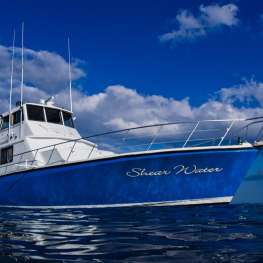
Fifty miles east of Miami, two narrow strips of land sit at the edge of the Gulf Stream where the shallow waters of the Great Bahama Bank drop away into the deep Atlantic. Bimini — North Bimini and South Bimini together spanning barely nine square kilometres — is one of the smallest and most storied islands in the Bahamas. Hemingway drank here. The rum runners stopped here. And every winter, from roughly December through March, the great hammerhead sharks arrive.
The great hammerhead (Sphyrna mokarran) is the largest of the hammerhead species — adults regularly exceed three metres, and the largest recorded individuals approach six. They are pelagic predators of the open ocean, rarely encountered at predictable locations, and historically among the most difficult shark species to dive with reliably. Bimini changed that equation. The combination of shallow, clear water on the sandy flats adjacent to the island, the seasonal concentration of southern stingrays that the hammerheads follow as prey, and decades of careful relationship-building between local guides and these individual animals have created a dive experience unique in the shark-diving world: close, extended, in-water encounters with wild great hammerhead sharks in conditions that allow genuine observation rather than fleeting glimpses.
Bimini is part of the Bahamas diving circuit, and its concentrated, seasonal hammerhead experience sits alongside the resident bull sharks and Caribbean reef sharks that make the island a year-round shark-diving destination of real substance. For divers whose specific ambition is a close encounter with a great hammerhead — one of the most impressive and least predictably encountered apex predators in the ocean — Bimini from December to March is the answer.
The Great Hammerhead Experience
Great hammerheads at Bimini are not baited or conditioned in the way that some shark-feeding dive operations work. The sharks that visit the Bimini shallows in winter do so because southern stingrays — their preferred prey — aggregate on the sandy flats in high numbers during the same seasonal window. The dive guides who have worked these animals for years know the individual sharks, track their arrival and behaviour through the season, and position divers in the water with an understanding of each animal's temperament and typical approach behaviour that transforms an encounter with a wild apex predator from a matter of luck into something considerably more reliable.
The standard Bimini hammerhead dive takes place on the sandy bottom in 4 to 8 metres of water — shallow enough that natural light floods the scene and photographers can shoot without strobes. The shark approaches along the bottom, the distinctive hammer-shaped cephalofoil swinging in the characteristic slow, side-to-side motion of a cruising great hammerhead. The animals are large — consistently three to four metres, occasionally larger — and the proximity of the encounter in shallow, clear water creates a visual scale that is simply not available in the blue-water mid-ocean hammerhead encounters of other destinations. You are not watching a hammerhead swim past at depth. You are lying on sand in eight feet of water while a three-hundred-kilogram apex predator passes close enough to count its teeth.
Encounters at Bimini are not guaranteed — great hammerheads are wild animals and their behaviour is subject to conditions, individual mood, and the natural variability of any wildlife experience. But the consistency of the Bimini hammerhead season, the expertise of the local guides, and the shallow, forgiving conditions have made this one of the most reliable great hammerhead encounters available anywhere, and operators consistently report that the majority of multi-day trips during the peak season result in at least one substantive encounter.
Why Explore Bimini by Liveaboard
Bimini is a small island and its dive sites are geographically concentrated — a liveaboard is not strictly required to dive here in the way that it is at remote destinations like Socorro Islands or Cocos Island. Day trips from Miami are possible, and some dive operators run day-boat hammerhead trips during the peak season. However, a liveaboard based at or operating out of Bimini offers meaningful advantages for the dedicated shark diver.
Great hammerhead encounters at Bimini are weather and conditions dependent. The sharks tend to be most active in the early morning and on days with calm conditions and good visibility. A liveaboard allows multiple dive days at the site, maximising the probability of encountering the sharks in optimal conditions — a critical advantage given that the hammerhead season is only three to four months long and not every day within that window produces encounters. The ability to be in the water at first light, to dive multiple sessions on productive days, and to remain on site through changing conditions gives liveaboard guests a substantially higher expected encounter rate than a single-day visit from the mainland.
Beyond the hammerheads, Bimini's year-round shark and reef diving benefits from the same principle: multiple days and multiple dives per day at the same sites produce cumulative encounters and behavioural observations that a single day cannot replicate.
Key Dive Sites
The Hammerhead Flats are the defining feature of Bimini's dive season and the primary reason for the island's international reputation. A series of shallow sandy flats on the western side of the island, the Hammerhead Flats are where the great hammerheads are most consistently found from December through March. Depths range from 4 to 10 metres, visibility is typically 15 to 25 metres in good conditions, and the open sandy bottom provides unobstructed sightlines for photography and observation. Dives here are bottom-time dives in the truest sense — divers kneel or lie on the sand and the sharks come to them.
Bull Shark Alley is Bimini's year-round shark-diving site and one of the most reliable bull shark encounters in the Bahamas. Bull sharks at Bimini are not baited; they are resident animals whose territorial familiarity with the site produces predictable sightings throughout the year. Bull sharks in the Bahamas are large, well-fed animals that display a very different behavioural profile from open-ocean bull sharks — calmer, more measured in their approach, and habituated to diver presence in a way that allows observation at close range without the nervous edge of a genuinely fresh encounter. This is not to say the encounters are without intensity — bull sharks are powerful, impressive animals and their proximity is visceral — but experienced Bimini guides manage the site and the animals with the confidence of long familiarity.
The Bimini Road (Road to Atlantis) is an underwater rock formation of rectangular limestone blocks arranged in a J-shaped pattern on the seafloor at 5 to 6 metres, located off the north coast of North Bimini. Whether it is a natural geological feature or something else has been debated enthusiastically since its discovery in 1968, and the debate contributes meaningfully to its draw as a dive site. The formation itself is genuinely unusual — the regular geometry of the blocks and their arrangement have been the subject of serious geological investigation as well as considerably less serious speculation — and it provides an excellent shallow reef dive regardless of its origins, with good coral and sponge growth and a reliable resident population of Caribbean reef sharks, nurse sharks, and stingrays.
The Victory Reef and Nodules are Bimini's main reef diving sites, providing the shallow coral and sponge reef communities that form the backbone of the island's non-shark diving. Caribbean reef sharks are present throughout. Green moray eels, spotted eagle rays, loggerhead sea turtles, and dense communities of snapper, grunt, and angelfish characterise the reef, which sits in the characteristically clear, warm waters of the Bahamas at depths of 8 to 18 metres.
The Bimini Drift is a current-fed site along the edge of the Bimini channel where the Gulf Stream influence creates drift diving conditions with good visibility and concentrations of pelagic and reef species drawn to the current edge. Experienced drift divers will find this a productive site for encounters with larger pelagics — silky sharks, oceanic whitetip sharks during the appropriate season, and schools of jacks and barracuda in the current.
The Sapona Wreck is a concrete-hulled cargo ship sunk in the 1920s and now sitting in 5 to 9 metres of water as an artificial reef. The hull is extensively colonised with corals and sponges, and the site is home to large resident grouper, moray eels, and nurse sharks resting beneath the hull sections. It is suitable for all experience levels and provides an accessible introduction to wreck diving in the calm, clear Bahamian shallows.
Marine Life
Bimini's marine ecosystem sits at the convergence of the shallow Great Bahama Bank and the deep Gulf Stream, creating a nutrient-rich transition zone that supports both the resident reef community and the seasonal influx of large pelagic species. The warm, clear water is characteristic of the broader Bahamas — exceptional visibility by Caribbean standards, water temperatures that remain comfortable year-round, and a reef ecosystem that benefits from the strong marine protection framework of the Bahamian government.
Great hammerhead sharks are the headline species from December to March. Bimini's shallow-water encounters with this species are unique globally — no other destination offers the same combination of reliability, proximity, and photographic conditions for great hammerheads that the Bimini Flats provide during peak season.
Bull sharks are present year-round and are among the most impressive resident shark populations in the Bahamas. The Bimini bull sharks are well-known individuals to the local guides, and repeat visitors often recognise specific animals across multiple trips.
Caribbean reef sharks are ubiquitous across all reef sites and are the most commonly encountered shark species at Bimini year-round. Their presence in numbers at every dive site gives Bimini a consistent ambient shark density that makes every dive feel distinctly different from Caribbean reef diving elsewhere.
Nurse sharks rest in aggregations under coral ledges and wreck sections at multiple sites. Spotted eagle rays patrol the reef edges. Southern stingrays are dense on the sandy flats — their concentration is the primary ecological driver of the great hammerhead visitation and makes the flats a productive independent dive site even when the hammerheads are not present.
Oceanic whitetip sharks pass through the deeper water around Bimini during seasonal movements — sightings are irregular but possible, particularly at the Bimini Drift site when conditions favour the species. Silky sharks are recorded in the deeper channel water. Lemon sharks — particularly juveniles — use the mangrove nursery habitat of South Bimini in high numbers; dedicated lemon shark juvenile encounters in the mangroves are offered by some operators as a snorkel experience.
Dolphins — Atlantic spotted dolphins — are frequently encountered in the waters around Bimini and are known for interactive behaviour with divers and snorkellers at several sites, particularly in the shallower water of the Bank.
Best Time to Dive Bimini
December to March is the great hammerhead season and the primary window for visitors whose specific goal is a great hammerhead encounter. Peak activity is typically January and February, when water temperatures have cooled to their annual minimum (22°C to 24°C) and the stingray aggregation that attracts the hammerheads is at its densest. This is the period when Bimini receives its highest volume of dedicated shark divers from across the world.
April to November offers excellent year-round diving with bull sharks, Caribbean reef sharks, reef fish, eagle rays, and the full range of Bahamian reef species — absent the great hammerheads, which have typically departed northward or into deeper water by April. Water temperatures rise to 26°C to 29°C, visibility remains excellent, and conditions are generally calmer than the winter months. Dolphin encounters are particularly frequent in the warmer months. Oceanic whitetip sightings, while never guaranteed, are possible from late spring through autumn in the deeper channel water.
For the most complete Bimini experience — hammerheads, bull sharks, reef diving, and the full ambient shark presence — January and February are the optimal months, combining peak hammerhead activity with the full year-round resident shark community.
Water Temperature and Visibility
Bimini's water temperature ranges from 22°C to 24°C in the winter months (December to March) to 27°C to 29°C in summer. A 3mm wetsuit is sufficient for summer diving; a 5mm is comfortable for winter and recommended particularly for multiple dives per day in the cooler months, when body heat loss across a full day of diving adds up.
Visibility at Bimini is among the best in the western Atlantic — typically 20 to 30 metres across most sites in good conditions, and occasionally higher on the outer edges near the Gulf Stream. The shallow flats can see reduced visibility after strong winds stir the sand, but these conditions typically clear within 24 to 48 hours. The clear water is a central feature of the Bimini hammerhead experience, enabling the wide-angle, well-lit photography that makes images from this destination so distinctive.
Diving Conditions
Bimini is one of the more accessible shark-diving destinations for a range of experience levels. The shallow depths of the primary hammerhead sites (4 to 10 metres), the absence of strong currents on the flats, and the warm, clear water make this a genuinely approachable destination for divers with moderate experience.
Most hammerhead dive operators recommend a minimum of Open Water certification with 20 to 30 logged dives. Advanced Open Water is not required for the flats dives, though good buoyancy control — specifically the ability to remain still on the sand without kicking up silt — is essential for the quality of the encounter. Divers who fin aggressively, struggle to maintain trim, or react nervously in the presence of the sharks significantly reduce the quality of the encounter for the entire group.
The Bimini Drift site and deeper channel dives require more experience and benefit from prior drift diving practice. Bull Shark Alley, while shallow, benefits from composure and the ability to maintain relaxed, controlled body position during close approaches.
Shark safety briefings at Bimini are thorough and should be taken seriously. The hammerheads and bull sharks are wild animals of significant size, and while serious incidents at well-managed Bimini operations are rare, respectful, attentive diving is not optional. Follow guide instructions precisely regarding positioning, movement, and approach distances.
The crossing from Miami to Bimini crosses the Gulf Stream — a 50-mile passage that can be choppy in adverse conditions, particularly in winter when northerly winds oppose the northward-flowing current. Most Bimini-based liveaboards operate within or from Bimini itself and do not require this crossing; operators who transfer guests from Miami should be consulted about sea conditions before departure.
Who Is Bimini For?
Bimini is for the diver who wants a specific, exceptional experience with a species that is genuinely difficult to encounter reliably anywhere else. The great hammerhead — the largest hammerhead species, an animal of extraordinary presence and prehistoric aspect — is rarely encountered in conditions that allow the kind of close, sustained observation that Bimini's shallow flats provide in winter. Divers who have seen scalloped hammerheads in schools at Cocos Island or the Galápagos will find the great hammerhead at Bimini a fundamentally different experience — not a distant school observed from the thermocline but a single, enormous animal passing within arm's reach in clear, shallow water.
It is also a destination for the underwater photographer who wants the great hammerhead in proper light. The combination of shallow depth, clear water, white sand bottom, and a shark that moves slowly through the frame — often pausing or circling — creates photographic conditions that do not exist at any other great hammerhead destination. Some of the most widely published great hammerhead images in the world have been taken at Bimini.
Beyond the hammerheads, Bimini offers the broader Bahamas shark-diving experience in concentrated form — comparable in reef shark density to Tiger Beach, more varied in species than any single Bahamas site. Divers who want a comprehensive introduction to Bahamas shark diving, or who want to build on a Tiger Beach experience with a different shark-diving context, will find Bimini a natural complement.
Practical Information
The Bahamas has no recompression chamber on Bimini itself; the nearest facilities are in Nassau or on the Florida mainland. Dive insurance with emergency medical evacuation coverage is strongly recommended.
Browse Bimini liveaboards on Dive and Cruise
Frequently Asked Questions
What makes Bimini's great hammerhead encounters different from hammerhead diving elsewhere?
Most hammerhead encounters around the world involve scalloped hammerheads (Sphyrna lewini) observed in schools from a distance — the classic experience at Cocos Island, the Galápagos, and the Sea of Cortez. Bimini offers great hammerheads (Sphyrna mokarran), a different and larger species, encountered individually in shallow, clear water at close range. The visual scale of a single 3 to 4-metre great hammerhead at 6 metres of depth in 25-metre visibility is fundamentally different from a school of smaller hammerheads observed at distance in green water. Both experiences are exceptional; they are not the same experience.
Is Bimini suitable for less experienced divers?
Yes, more so than most shark-diving destinations. The hammerhead flats sit at 4 to 10 metres with minimal current and excellent visibility — conditions that are technically accessible to Open Water divers with 20+ logged dives. The key requirement is not certification level but behavioural: divers must be able to remain calm and still on the sand during the encounter, with good buoyancy control and no tendency to fin aggressively or react nervously. Divers who meet this behavioural standard but have limited logged dives often have outstanding encounters; technically experienced divers who are nervous around sharks may find the experience more challenging.
When exactly do the great hammerheads arrive at Bimini?
The great hammerhead season at Bimini typically runs from mid-December through late March, with the most reliable and frequent encounters in January and February. The sharks' arrival correlates with cooling water temperatures and the congregation of southern stingrays on the flats. Some years the season starts in late November; in warm winters it may begin in January. Local operators track arrivals in real time and current-season reports are the most reliable guide to exact timing.
Part of Bahamas · Americas & Caribbean · Browse Bimini liveaboards on Dive and Cruise