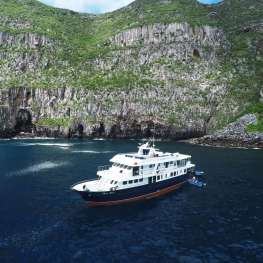
Five hundred kilometres off the Pacific coast of Colombia, rising from the floor of a 4,000-metre-deep ocean ridge, Malpelo Island is one of the most remote, most protected, and most extraordinary dive destinations on earth. This UNESCO World Heritage Site — a jagged volcanic rock formation barely 1.2 square kilometres above the waterline, surrounded by 38,756 hectares of protected marine sanctuary — is not a place you stumble upon. Getting here takes commitment: a 30-hour offshore passage from the port of Buenaventura, across open Pacific swell, on one of a strictly limited number of permitted liveaboards. There are no beaches, no resort, no day-trip option, no alternative. Malpelo is accessible by liveaboard alone, and only one vessel is permitted inside the marine park at any given time.
That exclusivity is precisely the point. The waters around Malpelo are among the most biologically productive in the eastern tropical Pacific, swept by the convergence of the California Current from the north and the Humboldt Current from the south — oceanic upwellings that drive a food chain of extraordinary density and drama. Hundreds of scalloped hammerhead sharks school over seamounts. Thousands of silky sharks move in colossal aggregations through the blue. Eagle rays cruise in formation past sheer volcanic walls. Whale sharks feed in the plankton-rich water to the north of the island. Sailfish — the fastest fish in the ocean — tear through baitballs with a speed and violence that makes every encounter visceral and unforgettable.
Malpelo is not a destination for every diver. It demands experience, preparation, and a willingness to accept that the ocean here operates on its own terms. For those who are ready, it delivers the kind of shark diving that exists nowhere else on the planet.
Why Dive Malpelo by Liveaboard
There is no other way. Malpelo Island has no harbour, no infrastructure, and no land-based accommodation of any kind beyond a small Colombian Navy outpost. The Colombian government has permitted only a handful of liveaboard operators to enter the marine sanctuary since 2018, and at any given moment only one vessel may be inside the park boundaries — a restriction that guarantees every dive group has the island's 30 dive sites entirely to themselves.
This one-liveaboard-at-a-time policy is not just a logistical detail — it fundamentally changes the quality of the experience. At popular dive destinations, even remote ones, the presence of multiple boats and competing dive groups affects animal behaviour and fragments the sense of wilderness that makes a site feel special. At Malpelo, there is no other boat. No other group. No competing current of bubbles rising from a dozen divers on the same cleaning station. Just your group, the volcanic walls, and whatever the Pacific decides to deliver that day.
Liveaboard itineraries to Malpelo typically run 9 nights to 11 nights, with approximately 7 full days of diving at the island after the crossing. Groups are capped at a maximum of 16 to 25 divers depending on the vessel, and individual dive groups are limited to 6 divers per guide — an intimacy of experience that the best liveaboard operations in the world rarely match.
Diving Style at Malpelo
Malpelo is pelagic diving in its purest form. The dive sites here are built around walls, pinnacles, seamounts, and open blue water rather than coral gardens or reef systems — though the volcanic structure of the island supports impressive hard coral cover at several sites, particularly on the northern side. Dives are predominantly drift dives in currents that can be powerful and unpredictable, and buoyancy control in open water is an essential skill rather than a nice-to-have.
The sharks, rays, and large fish that make Malpelo famous are animals of the open ocean — they move in three dimensions, they respond to current direction and thermoclines, and they can appear from nowhere and disappear just as quickly. The most productive dives are often those spent hovering patiently in the blue at depth, waiting for a passing school of hammerheads rather than actively pursuing them. Hammerheads are sensitive to sound and light — photographers should wait for the right moment before triggering strobes, as premature flashing will push a school away. The thermoclines that mark the boundary between warm surface water and cold upwelling are often exactly where the largest concentrations of hammerheads are found, and dropping through them — even into uncomfortably cold water — is frequently rewarded.
Depths across the main dive sites range from 7 metres on the shallow hammerhead cleaning stations to well beyond 40 metres on the outer walls and pinnacles. Most productive dives happen at 20 to 35 metres. Nitrox is strongly recommended to extend bottom time at depth and maximise the dive window at the island's best sites.
Key Dive Sites
La Nevera (The Freezer) sits on the cold-water southern side of the island, where powerful upwellings bring frigid water to the surface and concentrate marine life in extraordinary numbers. Vast schools of hammerheads, silky sharks, eagle rays, mantas, and pelagic fish aggregate at this site. The name refers to the cold — divers should be prepared for thermocline temperatures that can drop sharply from surface warmth to genuinely cold water at depth.
El Cathedral is one of Malpelo's most structurally dramatic sites — a submerged pinnacle with a natural tunnel passing through it from a sandy bottom at 18 metres almost to the surface. The tunnel walls are covered in corals and sponges, and the interior supports whitetip reef sharks, moray eels, snappers, eagle rays, and grunts. Outside the pinnacle, open-water hammerhead encounters are a regular feature.
La Gringa on the southern end of the island features a large cave passing through its main pinnacle at 24 to 40 metres, and on clear days the visibility from the site allows three distant seamounts to be seen simultaneously. A permanent school of bigeye jacks inhabits the exposed face of the rock, and Galápagos sharks visit alongside the more numerous hammerheads.
El Bajo is an open-water seamount site that concentrates pelagic life in numbers that can be staggering on a good day — hammerheads in schools of 200 or more, silky sharks in the thousands, sailfish, tuna, and eagle rays circling in the blue water above.
La Cara del Fantasma (The Face of the Ghost) is located between Arrecifes and El Bajo and is notable for its large resident school of Pacific barracuda alongside whitetip reef sharks, hammerheads, and dense populations of blue and gold snappers — one of the most photogenic sites for wide-angle reef photography at Malpelo.
Marine Life by Season
Malpelo's marine life is present year-round, but different species peak at different times. The island's position at the Intertropical Convergence Zone means conditions shift seasonally as trade winds from both hemispheres meet and influence the ocean currents.
From January to March, cold water upwellings bring hammerheads into unusually shallow water — cleaning station encounters at 7 to 15 metres are possible during these months, dramatically improving photography conditions. This is also the best period for encountering the short-nosed ragged-tooth shark (sand tiger shark), a deep-water species that visits shallower depths here during the cold season in one of the only reliably documented surface-accessible locations in the Pacific. Surface conditions can be rougher due to north winds, and visibility can drop when plankton blooms reduce it to 10 metres — though the marine life these blooms attract is a more than fair trade.
From April to June, water temperatures warm gradually and baitball activity increases — June is the best month for explosive baitball encounters, with sailfish, tuna, and dolphins driving sardines and smaller fish to the surface in coordinated hunting events that are among the most dramatic wildlife spectacles available to divers anywhere.
From May to October, whale sharks are at their most frequently encountered, with August and September the peak months. The northern side of the island is the most productive area for whale shark sightings.
From May to December, large aggregations of silky sharks are possible when baitballs are present, making this the most productive window for encounters with this species in quantity.
Water temperature ranges from 16°C to 25°C from January to April — a 7mm wetsuit or semi-dry suit is strongly recommended. From May to December, temperatures rise to a more comfortable 26°C to 28°C, and a 5mm wetsuit is adequate for most divers.
Best Time to Dive Malpelo
Malpelo can be dived year-round, and liveaboard departures operate throughout the calendar. Each season has genuine strengths:
For shallow hammerhead encounters and the best chance of the rare ragged-tooth shark, January to March is the most productive window despite the colder water and sometimes rougher surface conditions.
For baitballs, sailfish, and the broadest range of species simultaneously, April to June offers the most dynamic and varied diving.
For whale sharks and the warmest water, May to October is optimal — particularly August and September for whale shark frequency.
For the best overall balance of conditions, species diversity, and comfortable water temperature, May to July is widely considered the sweet spot at Malpelo, delivering warm water, active baitballs, whale shark potential, and reliable hammerhead schools simultaneously.
Water Temperature and Visibility
Water temperature at Malpelo is highly variable by season and thermocline. Surface temperatures range from 16°C to 25°C from January to April, and 26°C to 28°C from May to December. Thermoclines can create sharp drops of 5°C or more at depth at any time of year, and the coldest, most productive water is often found precisely where the sharks are most concentrated. Divers should pack for the cold season even when visiting in warmer months, as thermoclines are unpredictable.
Visibility is equally variable. In optimal conditions — typically during the warmer months — visibility at Malpelo exceeds 30 metres and can reach up to 40 metres at offshore pinnacles, making the blue-water photography some of the finest in the eastern Pacific. During plankton blooms driven by cold upwellings, visibility can reduce to 10 metres — a trade-off that most Malpelo veterans consider worthwhile given the marine life those blooms attract.
Diving Conditions
Malpelo is an advanced diving destination without exception. Currents are strong, variable, and can change direction and intensity with little warning — drift diving is the norm rather than the exception, and the ability to manage a reef hook, control ascent in open water, and navigate unpredictable current conditions is essential. Wave action on the surface can make entries and exits from the dive tender challenging, and crossings between sites in rough conditions require a degree of physical tolerance that some divers may find demanding.
Nitrox is strongly recommended for all diving at Malpelo, both to extend bottom time at depth and to reduce nitrogen loading during multiple daily dives. The nearest decompression chamber is in Cali — a 30-hour passage away — which makes conservative dive profiles and strict adherence to computer limits not just advisable but critical. Dive groups are limited to 6 divers per guide, ensuring close supervision and the ability to manage each diver's profile individually.
The Colombian park authority requires a minimum of Advanced Open Water certification and 25 logged dives for entry. Most experienced operators and guides strongly recommend a minimum of 50 logged dives and prior experience with open-ocean drift diving before attempting Malpelo — this is not a destination to use as an introduction to liveaboard diving, however compelling the marine life.
Who Is Malpelo For?
Malpelo is for experienced divers who have moved beyond the point where the act of diving is itself the challenge, and who are now seeking encounters that push against the outer limits of what the ocean can deliver.
It is the destination of choice for dedicated shark divers — those for whom a dozen reef sharks at a cleaning station is a pleasant but unremarkable experience, and who are seeking something on a genuinely different scale. Witnessing 200 scalloped hammerheads cycling above a seamount, or a colossal aggregation of silky sharks rolling through a baitball, belongs to a different category of experience entirely.
It is also one of the finest destinations in the world for wide-angle underwater photographers willing to accept the challenge that unpredictable conditions and fast-moving, shy animals present. The blue-water clarity during the warm season, the shark schools, the sailfish during baitball season, and the structural drama of the volcanic walls create a photographic environment that few other locations can match.
Finally, Malpelo attracts the kind of diver who values exclusivity and wilderness — the knowledge that the entire marine park is theirs for the duration of the trip, undiluted by other groups, other boats, and the compromises that popular access inevitably brings.
Practical Information
Liveaboards depart from Buenaventura on the Colombian Pacific coast. The closest major airport is Alfonso Bonilla Aragón International Airport in Cali (CLO), approximately 2.5 hours by road from Buenaventura. Cali has non-stop international connections from the USA, Spain, Panama, and Ecuador, and domestic connections from Bogotá. Arriving at least one day before departure is strongly recommended to allow for any luggage or transfer delays.
Itineraries are typically 9 to 11 nights, with 7 full diving days at the island. Groups are capped at 16 to 25 divers depending on the vessel, with dive groups limited to 6 divers per guide. Nitrox is available on all current Malpelo liveaboards. A 5mm wetsuit is the minimum recommendation; a 7mm or semi-dry suit is advisable from December to April. An SMB (surface marker buoy), dive computer, and whistle are mandatory equipment for all divers at Malpelo — these requirements are enforced by the park authority, not operator preference.
Browse Malpelo liveaboards on Dive and Cruise
Frequently Asked Questions
How long is the crossing to Malpelo?
The passage from Buenaventura to Malpelo takes approximately 29 to 32 hours each way, depending on sea conditions and vessel speed. This means that on a 9-night itinerary, roughly 2 to 3 days are spent in transit, with 7 full days of diving at the island.
How many hammerheads can you actually see?
School sizes vary enormously by conditions, season, and dive site. On good days at El Bajo or La Nevera, schools of 100 to 300 scalloped hammerheads are documented. Silky shark aggregations — particularly when baitballs are present — can number in the thousands. These are not guaranteed figures for any given dive, but they are realistic descriptions of what the island produces at its best. Most divers who visit Malpelo over a full week will see hammerheads on the majority of their dives.
Do I need special insurance for Malpelo?
Yes — dive insurance covering decompression sickness and emergency medical evacuation is essential at Malpelo given the distance from any decompression facility. DAN (Divers Alert Network) or equivalent coverage is strongly recommended. The nearest recompression chamber is in Cali, a full ocean crossing away, which underscores the importance of conservative dive profiles throughout the trip.
What certification and experience do I need?
The Colombian park authority requires a minimum of Advanced Open Water certification and 25 logged dives. Most operators and experienced Malpelo guides recommend a minimum of 50 logged dives and prior experience with open-ocean drift diving. Comfort in strong currents, good buoyancy control in blue water, and experience managing SMBs in open-ocean conditions are the practical skills that most matter here.
Part of Americas & Caribbean · Browse Malpelo liveaboards on Dive and Cruise