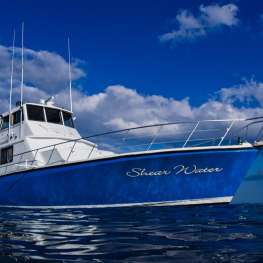
There is a shallow sand flat on the northwest edge of the Grand Bahama Bank, not far from the island of Grand Bahama, where the water is warm and clear and about fourteen metres deep. There are no dramatic topographic features — no walls, no pinnacles, no current-swept seamounts. Just sand, and a handful of Caribbean reef sharks drifting through the frame, and then, with the unhurried inevitability that characterises this place above all others, the tiger sharks arrive.
Tiger Beach is the most reliably productive tiger shark dive site on earth. That claim is not marketing language — it is the assessment of the underwater photographers, shark researchers, and documentary filmmakers who have made this site the most widely documented tiger shark habitat ever recorded. On a typical day at Tiger Beach during the peak season, a diver can expect multiple tiger sharks — sometimes four, five, or six individuals simultaneously — moving through a scene that also includes a dozen lemon sharks stacked in the water column and a permanent escort of Caribbean reef sharks. On exceptional days, a great hammerhead materialises from the blue periphery and joins the assembly, and the diver finds themselves surrounded by three of the most impressive shark species in the Atlantic in water that barely reaches fifteen metres.
The tiger shark (Galeocerdo cuvier) is the second-largest predatory shark in the ocean after the great white. Adults regularly exceed four metres and can approach six; they are unmistakable in profile — the broad, blunt snout, the robust body, the distinctive vertical dark stripes that give the species its name and that fade with age but never entirely disappear. They are also one of the most curious and behaviourally complex of all shark species — an animal that investigates, approaches, circles, and interacts with the environment with a deliberateness that feels distinctly purposeful. A tiger shark at close range in clear, shallow water is one of the most affecting wildlife encounters available to a scuba diver. Tiger Beach is where that encounter is most reliably available.
Tiger Beach is part of the Bahamas diving circuit, and its concentrated, accessible tiger shark experience sits at one end of the Bahamas shark-diving spectrum — the most intense and focused end — alongside the great hammerhead encounters at Bimini and the broader marine variety of the Exuma Cays.
The Shark Experience
Tiger sharks at Tiger Beach are attracted by bait — a fact worth understanding clearly before arriving. The operation involves chumming and bait presentation managed by experienced dive guides, which brings the sharks to a predictable location at predictable proximity and sustains their presence in the area long enough for extended dives. This is a managed encounter, not a wild chance meeting, and it is managed with the professionalism and safety standards that decades of operation at this specific site have produced.
The ethical and conservation dimensions of shark-feeding dives are debated in the diving community, and any diver considering Tiger Beach should engage with that debate. What is not in question is the safety record: Tiger Beach operations have been running since the mid-2000s and have produced an extraordinary volume of close-contact tiger shark encounters without a serious incident at any responsible operation. The sharks are wild animals whose behaviour remains natural and unpredictable — they are not domesticated or trained — but the experience of the local guides in reading individual animals, positioning divers, and managing the encounter environment is as deep as anywhere in the world.
What the bait operation produces is time — extended, uninterrupted time with tiger sharks in conditions that allow genuine observation. A single dive at Tiger Beach during peak season can involve 45 to 60 minutes on the sand at 12 to 14 metres, during which multiple tiger sharks circle, approach, and interact with the guide and divers in the immediate foreground. The sharks come close. Not ambiguously close — genuinely, viscerally close, at arm's length or less, investigating the bait and the divers with the slow, unhurried confidence of animals that feel no threat in their environment.
The lemon sharks at Tiger Beach are a secondary highlight that would be the headline attraction at almost any other destination. Lemon sharks (Negaprion brevirostris) at Tiger Beach are present in numbers — typically ten to twenty individuals — stacked in the water column between the sand and the surface, circling with the perpetual, frictionless movement of animals in their element. They are large, beautiful, and at Tiger Beach thoroughly habituated to diver presence. In quieter moments between tiger shark approaches, watching a column of slowly rotating lemon sharks against the shaft of Bahamian sunlight is an experience of sustained visual quality.
Great hammerheads appear at Tiger Beach irregularly but with sufficient frequency to be considered a realistic possibility on any multi-day visit, particularly during the cooler months from December to March. Their appearance at a Tiger Beach dive — already populated by tiger sharks and lemon sharks — creates the kind of multi-species shark assembly that exists nowhere else on earth at this level of accessibility.
Why Dive Tiger Beach by Liveaboard
Tiger Beach is located on the shallow banks northwest of Grand Bahama Island, accessible by boat from West End or Freeport. Day trips are possible and are offered by some Grand Bahama operators. However, a liveaboard provides a substantially superior experience for the dedicated shark diver.
The tiger sharks at Tiger Beach are not present in equal numbers and equal frequency throughout every day. Activity tends to peak in the morning and in the late afternoon; midday periods can be slower. A liveaboard allows multiple dives across the full day — early morning, midday, afternoon, and in some cases at dusk or after dark — maximising both the total time with the sharks and the probability of being in the water during peak activity windows. The ability to dive the site four times in a day and to repeat this across three, four, or five consecutive days dramatically elevates the expected quality and depth of the encounter experience compared to a single day visit.
Night diving at Tiger Beach is one of the most extraordinary experiences the site offers and is available only on a liveaboard. After dark, the tiger sharks' behaviour shifts — they become more active, more exploratory, and in many accounts more impressive — and the ambient darkness of the site at night focuses attention on the immediate circle of torch-lit water in a way that concentrates the visual impact of a shark encounter to an almost overwhelming degree.
Key Experiences and Dive Sites
The Main Tiger Beach Site is the sandy flat at 12 to 14 metres where the principal bait-assisted encounters take place. There is no complex topography to navigate — the dive consists of descending to the sand, taking up a position as directed by the guide, and observing. The clarity of the Bahamian water and the shallow depth mean that the entire water column above is visible — tiger sharks approaching from any direction are seen well in advance, lemon sharks fill the mid-column, and the sunlit surface forms a bright backdrop that makes wide-angle underwater photography here extraordinarily effective. Many of the definitive tiger shark images in existence were taken at this specific location in these specific conditions.
Shark Alley and Deeper Bank Sites are secondary locations within the broader Tiger Beach area where the guide may move divers depending on shark distribution, conditions, and the specific animals present on a given day. These sites offer some variation in depth and topography but maintain the same basic operational format as the main site.
Night Dives at Tiger Beach are conducted at the same location as the day dives but produce a fundamentally different experience. The tiger sharks are more active at night, the lemon sharks increase in energy and proximity, and the darkness reduces the spatial awareness that day diving provides — making each approaching shark a more sudden and immediate presence. Night diving at Tiger Beach is considered by many experienced shark divers to be the single most intense shark-diving experience available anywhere.
Reef Diving on Grand Bahama's South Shore is available as a complement to Tiger Beach for liveaboards that include a transit or stopover near Grand Bahama Island. The reefs here are typical of the northern Bahamas — good coral coverage, Caribbean reef shark presence, reef fish diversity — and provide a useful contrast to the open-sand tiger shark experience as well as giving less experienced divers a more familiar dive environment.
Marine Life
Tiger Beach's marine life is dominated by the shark species for which it is named, but the full assembly of species present on a productive day is one of the most impressive multi-species shark encounters anywhere in the ocean.
Tiger sharks are the defining species and the primary reason every diver comes. The individuals that visit Tiger Beach regularly are known to the local guides — many have been named and are recognised across multiple seasons. The resident population typically includes animals from 2.5 to over 4 metres, with occasional individuals approaching 5 metres. Tiger sharks are characteristically curious and investigative — they approach the bait zone repeatedly, sweep past divers at close range, and display a behavioural complexity — the slow head-swinging investigation, the sudden acceleration, the circling approach — that rewards extended observation in a way that more predictable animals do not.
Lemon sharks are present in significant numbers year-round, typically 10 to 20 individuals. They form the perpetual background of the Tiger Beach experience — always present, always moving, genuinely impressive animals in their own right. Large adult lemon sharks at Tiger Beach regularly exceed 2.5 metres and display a calm confidence that speaks to years of familiarity with the site.
Caribbean reef sharks are ubiquitous throughout the site and provide the ambient backdrop against which the larger species interact. Their numbers at Tiger Beach are higher than at most reef sites — a function of both the bait operation and the shallow bank's general productivity.
Great hammerhead sharks appear irregularly, primarily from December through March, and their presence at Tiger Beach when the tiger sharks and lemon sharks are also active creates an encounter of almost absurd multi-species richness. A Tiger Beach dive with a great hammerhead in attendance is considered by experienced shark divers to be among the finest hours available in the ocean.
Nurse sharks rest on the sand throughout the dive and occasionally get involved in the action in the bait zone. Spotted eagle rays pass through the scene. Caribbean reef fish — snapper, grunt, angelfish — provide the ecological context that makes Tiger Beach feel like a functioning reef environment rather than a managed spectacle.
Best Time to Dive Tiger Beach
Tiger Beach operates year-round, and tiger sharks are present at all times of year — this is one of its defining advantages over more strictly seasonal shark-diving destinations.
October to March is the peak season and the period most commonly recommended for first-time visitors. Water temperatures are at their coolest (24°C to 26°C) and the tiger sharks are at their most active and most reliably present in high numbers. This is also the window when great hammerhead sharks are most likely to appear. The winter months at Tiger Beach tend to produce the highest tiger shark counts — four, five, or six individuals simultaneously is more common in winter than in summer — and the calmer sea conditions of the Bahamian winter make liveaboard operations more comfortable.
April to September offers warmer water (27°C to 30°C) and somewhat lower tiger shark density, but the sharks are still reliably present and encounters remain excellent. Summer at Tiger Beach is quieter in visitor numbers, which some divers prefer — fewer divers in the water translates to less competition for position at the guide station and a more spacious encounter environment. The great hammerhead frequency drops significantly outside the December-to-March window.
For the most intense tiger shark experience — maximum shark numbers, great hammerhead possibility, and the full range of species simultaneously — November to February is the optimal window.
Water Temperature and Visibility
Water temperature ranges from 24°C to 26°C in winter to 27°C to 30°C in summer. A 3mm wetsuit is comfortable in summer; a 5mm is recommended in winter, particularly for multiple dives per day on the cooler days of January and February.
Visibility at Tiger Beach is among the finest in the Bahamas — the shallow bank water is extraordinarily clear, and 25 to 30 metres of visibility is typical in good conditions. This exceptional clarity is a central feature of the Tiger Beach experience: the ability to see a four-metre tiger shark approaching from twenty metres away gives divers time to compose themselves and their cameras in a way that high-adrenaline, low-visibility shark encounters do not. The quality of underwater photography at Tiger Beach reflects these conditions directly — the combination of clear water, white sand bottom, and natural Bahamian sunlight at 14 metres produces images of a quality that shark photographers specifically seek out.
Diving Conditions
Tiger Beach is one of the most technically accessible shark-diving destinations in the world. The shallow depth (12 to 14 metres), minimal current, exceptional visibility, and warm water remove most of the physical and technical challenges that make other high-intensity shark experiences demanding. There is no strong current to manage, no thermocline to descend through, no blue-water orientation required.
The experience requires a different kind of preparation: psychological readiness and behavioural composure around large apex predators at close range. This is not a scare-mongering caveat — the vast majority of divers who visit Tiger Beach find the experience manageable, controllable, and profoundly rewarding. But it is worth acknowledging that a diver's primary challenge at Tiger Beach is not technical diving skill but the ability to remain calm, still, and controlled when a four-metre tiger shark passes within a metre of their face.
Most Tiger Beach operators require a minimum of Open Water certification with 25 to 30 logged dives. Advanced Open Water is not technically required for the conditions, but experience helps — divers who have managed their buoyancy in varied conditions, who are comfortable on the bottom for extended periods, and who have some prior experience with shark encounters will get more from the Tiger Beach experience than those for whom every element is simultaneously new.
Shark safety protocols at Tiger Beach are non-negotiable and comprehensive. Every dive begins with a detailed briefing covering positioning, permitted and prohibited movements, guide signals, and emergency procedures. Divers must follow guide instructions precisely during the encounter — departures from instructed positioning are the primary source of incidents at any managed shark-dive operation, and Tiger Beach is no exception. Responsible operators enforce these protocols rigorously, and guests should treat them as the fundamental condition of participation rather than optional guidance.
Who Is Tiger Beach For?
Tiger Beach is for any diver who has ever wanted to be in the water with a tiger shark and wants the encounter to happen in conditions where the animal can be properly observed, the photography can be properly composed, and the experience can extend beyond a heart-pounding second to something that can be genuinely understood and absorbed.
The combination of reliability, accessibility, and visual quality makes Tiger Beach the answer to a specific question that many divers carry: what is the closest I can get to a large, wild tiger shark in conditions where I can see it coming, keep it in frame, and have enough time to take it in? The answer, for every serious shark diver who has visited, is Tiger Beach.
It is also for the underwater photographer in a very direct sense. Tiger Beach has produced more widely published, technically excellent tiger shark images than any other location on earth. The conditions — the light, the depth, the clarity, the sand bottom, the shark's unhurried pace — are optimised for wide-angle close-focus photography in a way that no other tiger shark habitat provides. Photographers who have spent careers trying to capture a definitive tiger shark image and who have never found the conditions elsewhere typically find them here.
For divers building a Bahamas shark-diving itinerary, Tiger Beach anchors the northwestern end of the experience — the most concentrated, most intense, most specifically shark-focused site in the chain. It pairs naturally with Bimini for a great hammerhead encounter and with the Exuma Cays for a broader Caribbean reef and wildlife experience. Together, the three destinations cover the full spectrum of Bahamas diving from wild reef ecology to apex predator encounters.
Practical Information
Tiger Beach is located on the Great Bahama Bank, northwest of Grand Bahama Island. Most liveaboard operations depart from West End or Freeport, Grand Bahama Island, accessible via Grand Bahama International Airport (FPO) with connections from Miami, Fort Lauderdale, Nassau, and other Florida gateways. Some operators depart from Nassau (NAS) or Fort Lauderdale (FLL) directly, with the passage to Tiger Beach taking 4 to 8 hours depending on vessel speed and departure point. Operators provide detailed embarkation logistics at time of booking.
Standard Tiger Beach liveaboard itineraries run 4 to 7 nights. Most itineraries focus entirely on Tiger Beach and the surrounding bank, with 4 - 5 dives per day including a night dive. Some operators combine Tiger Beach with a transit to other Bahamas shark sites. Nitrox is available on most current Tiger Beach liveaboards. A 3mm wetsuit suffices in summer; 5mm is recommended in winter. An SMB is recommended for all open-water ascents.
There is no recompression chamber on Grand Bahama Island itself, the nearest facilities are in Florida. Dive insurance with emergency medical evacuation coverage is strongly recommended and should be confirmed active before departure.
Browse Tiger Beach liveaboards on Dive and Cruise
Frequently Asked Questions
Are the tiger sharks fed or baited at Tiger Beach?
Yes — the operation uses bait and chum to attract and retain tiger sharks at the site. This is a managed encounter, not a chance wildlife sighting, and it is worth understanding clearly before booking. The bait operation allows the sharks to be present in predictable numbers and at predictable proximity for extended periods — the encounters typically lasting 45 to 60 minutes — which would not be possible in an un-baited setting. The ethics of shark-feeding dives are genuinely debated in the diving community, and divers should engage with that debate before deciding whether Tiger Beach aligns with their values. What is clear is the safety record: decades of operation at this site without a serious incident at any responsibly managed operation.
Is Tiger Beach suitable for divers who are nervous around sharks?
Tiger Beach is probably not the right destination for divers who are significantly uncomfortable around sharks in general. The encounter is immersive — multiple large sharks at close range for extended periods — and it cannot be made less intense on demand if a diver becomes overwhelmed. For divers who are mildly uncertain but want to push their comfort boundary in a structured, guided environment, Tiger Beach with an experienced operator is often a transformative experience — many visitors describe it as entirely changing their relationship with sharks. The key is honesty with yourself and with your operator before booking about where your comfort level actually sits.
What is the difference between Tiger Beach and Bimini?
Both are world-class Bahamas shark destinations but they offer fundamentally different experiences. Tiger Beach is a bait-assisted encounter with tiger sharks — large, individually impressive animals encountered at close range in a managed, sustained dive — and is available year-round. Bimini offers seasonal encounters with great hammerhead sharks in a non-baited setting, where the hammerheads visit naturally in pursuit of stingrays. Tiger Beach is more reliably consistent; Bimini's hammerhead encounters are natural but seasonal. Many serious Bahamas shark divers combine both sites in a single trip.
Part of Bahamas · Americas & Caribbean · Browse Tiger Beach liveaboards on Dive and Cruise