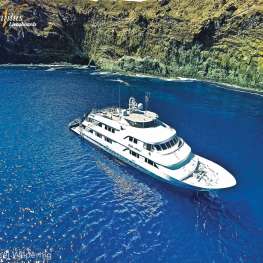
Jacques Cousteau called it the aquarium of the world. The Sea of Cortez — also known as the Gulf of California — is a narrow tongue of ocean wedged between the Baja California Peninsula and the Mexican mainland, running roughly 1,100 kilometres from its open Pacific mouth to its northern terminus in the desert. It is one of the most biologically productive bodies of water on earth, home to more than 900 species of fish, a third of the world's marine mammal species, and a concentration of endemic and migratory marine life that has made it a UNESCO World Heritage Site and one of the most compelling dive destinations in the western hemisphere.
What makes the Sea of Cortez distinct from Mexico's Pacific island destinations — Socorro Islands in particular — is not the scale of individual encounters but the sheer variety of what a single itinerary can deliver. A liveaboard week in the Sea of Cortez can include morning snorkelling with whale sharks near La Paz, an afternoon dive with a boisterous colony of California sea lions at Los Islotes, a night dive revealing a carpet of sleeping whitetip reef sharks, a mobula ray aggregation of thousands of individuals visible from the surface and from depth, and a hammer-head sighting in the blue water of the outer seamounts — all before the halfway point of the trip. The diversity here is not a marketing claim. It is a function of the Sea of Cortez's exceptional oceanographic position and the protection afforded by its UNESCO designation and the surrounding national parks and biosphere reserves.
The Sea of Cortez is also one of the more accessible liveaboard destinations in the eastern Pacific. It departs from La Paz or Cabo San Lucas — both served by Los Cabos International Airport with frequent connections from the United States — and typical itineraries run 7 to 8 nights without any offshore ocean crossing. For divers looking to experience world-class marine encounters without the logistical demands of Cocos Island or Socorro Islands, the Sea of Cortez is the natural starting point.
Why Dive the Sea of Cortez by Liveaboard
The Sea of Cortez spans a vast and varied geography — from the deep central basin to the shallow northern flats, from the rocky island reefs of the Midriff Islands to the open-water seamounts off the southern Baja tip. No single land-based location provides access to more than a fraction of this range. A liveaboard itinerary covers the entire relevant diving geography in a single trip: the whale shark aggregation areas near La Paz, the sea lion colonies at Los Islotes, the hammerhead and mobula ray sites at the outer islands, and the deeper seamounts of the central sea.
The diversity of ecosystems within a single itinerary is genuinely unusual. Shallow mangrove channels and sandy bays provide nursery habitat for juvenile rays and sharks. Rocky reefs host dense communities of reef fish endemic to the Sea of Cortez. Open-water passages concentrate mobula rays in aggregations that — at peak season — number in the tens of thousands, creating one of the most spectacular surface and subsurface wildlife spectacles available anywhere on earth. Deeper seamounts and island edges concentrate hammerheads, tiger sharks, and whale sharks passing through on seasonal movements.
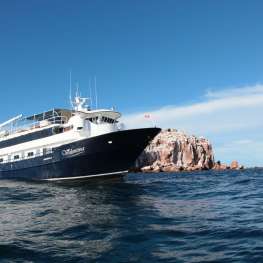
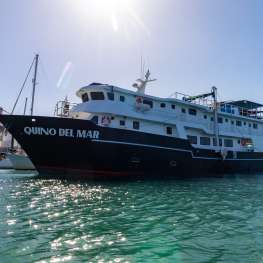
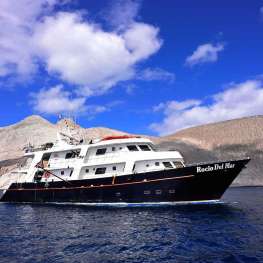
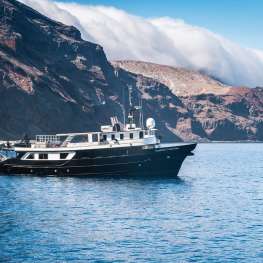
Most Sea of Cortez liveaboards carry between 10 and 20 guests and operate a mix of scuba dives, snorkelling sessions — particularly useful for whale shark interactions, which are managed as snorkel-only encounters at many sites — and surface wildlife watching. Guides on responsible Sea of Cortez operators typically hold specialist marine biology or natural history qualifications and provide an ecological context to each encounter that substantially enriches the experience.
Key Dive Areas
Los Islotes is the signature dive site of the southern Sea of Cortez and one of the most celebrated sea lion dive sites in the world. A small rocky islet at the northern end of Isla Espíritu Santo, Los Islotes hosts a permanent colony of several hundred California sea lions whose juveniles — bold, acrobatic, and completely uninhibited — interact with divers in extended play sessions that consistently rank among the most joyful wildlife encounters available in scuba diving. Sea lion pups approach, nip at fins, blow bubbles in masks, and engage in synchronized spirals around divers that continue for as long as divers remain in the water. The adults, including large territorial bulls, add a degree of unpredictability that experienced guides manage with clear pre-dive briefings. The surrounding reefs host dense communities of reef fish, moray eels, and octopus.
Isla Espíritu Santo is the larger island complex surrounding Los Islotes and the geographic heart of the southern Sea of Cortez diving. The island's protected bay system and varied coastline produce a range of dive environments — rocky pinnacles swept by current that concentrate hammerheads and eagle rays, sheltered sandy bays with garden eels and rays, shallow reef zones with endemic reef fish, and deeper walls with good soft coral coverage. The island is a protected biosphere reserve and UNESCO World Heritage Site; fishing is prohibited and the marine life density reflects decades of effective protection.
El Bajo Seamount is the Sea of Cortez's premier pelagic site — a shallow underwater mountain rising from 300 metres to within 20 metres of the surface, located about 40 kilometres northeast of La Paz. El Bajo is the site most consistently associated with scalloped hammerhead aggregations in the Sea of Cortez, particularly during the summer months when water temperatures are at their highest and the hammerheads concentrate around the seamount's pinnacles in schools that can number in the dozens to low hundreds. Silky sharks, Galápagos sharks, manta rays, and whale sharks are also recorded at El Bajo, and the seamount's open-water setting produces occasional encounters with oceanic species rarely seen at inshore sites.
The Midriff Islands (Islas del Golfo) — including Isla Ángel de la Guarda, Isla Tiburón, and the smaller islands of the central gulf — represent the wildest and most remote diving in the Sea of Cortez. This region is where the cold, nutrient-dense waters upwelling from the deep central basin meet the island topography, concentrating marine life in extraordinary density. Fin whales, blue whales, sperm whales, and orcas move through the Midriff region on seasonal movements. Whale shark aggregations here can be exceptional in scale. The diving is more challenging — stronger currents, colder water, more variable conditions — and this section of the Sea of Cortez is generally included only on longer itineraries of 10 nights or more.
Cabo Pulmo National Park, on the eastern cape of Baja California, is one of the great marine conservation success stories of the past three decades. Once heavily overfished, Cabo Pulmo was declared a national park in 1995 and allowed to recover completely; the resulting transformation of its reef ecosystem has been documented as one of the fastest and most complete marine recovery events ever recorded. Today it hosts the only living coral reef in the eastern Pacific outside the Galápagos, with biomass levels that have increased by over 460% since protection began. Bull sharks, tiger sharks, schools of hundreds of jacks, and enormous aggregations of reef fish characterise the park's diving in a way that could not have been imagined before protection was established.
La Paz Bay and its surrounding shallows are the primary location for whale shark snorkelling — the largest seasonal aggregation of whale sharks in the Pacific, active from October to April, with peak numbers from November to March. Whale shark interactions at La Paz are managed as snorkel encounters (scuba is not typically permitted at the aggregation sites to avoid disturbing the feeding animals), but the quality and intimacy of the encounters — with animals feeding on plankton-rich surface water within easy snorkelling range — make this one of the most accessible large-animal wildlife experiences in the world.
Marine Life
The Sea of Cortez's biological richness is a product of its geography. The narrow enclosed sea amplifies tidal effects, generating strong tidal currents that drive upwelling and nutrient cycling at extraordinary rates. The meeting of Pacific and Gulf water masses at the southern mouth creates productivity gradients that sustain both warm-water tropical species and cold-water temperate species simultaneously. The result is an overlapping community of marine life drawn from both the Indo-Pacific and eastern Pacific faunal provinces, supplemented by a substantial community of endemic species found nowhere else.
Whale sharks are present in La Paz Bay from October to April in one of the world's largest reliably recurring seasonal aggregations — hundreds of individuals feeding in the shallow, plankton-rich waters. This is primarily a snorkelling experience but is among the most reliable whale shark encounters in the world.
Mobula rays — particularly the Munk's devil ray, endemic to the Sea of Cortez — form aggregations that are among the most spectacular natural events in the ocean. In summer months, schools of tens of thousands of mobula rays move through the central Sea of Cortez in formations visible from the surface and from depth, leaping from the water in the characteristic breaching behaviour that makes them one of the most dramatic subjects in underwater photography.
California sea lions at Los Islotes and throughout the island chain are the most interactive and reliably entertaining animal encounters in the Sea of Cortez — a marine mammal genuinely interested in playing with divers in a way that no other species in the eastern Pacific matches.
Scalloped hammerhead sharks aggregate at El Bajo seamount through the summer months, with schools of dozens to hundreds forming around the pinnacle during morning dives. The hammerhead experience at the Sea of Cortez is less overwhelming in scale than at Cocos Island or Socorro Islands but is accessible in warmer water and gentler conditions, making it a strong introduction to this kind of pelagic diving.
Bull sharks and tiger sharks appear with regularity at Cabo Pulmo and at some of the outer island sites — Cabo Pulmo in particular is one of the most reliable bull shark sites in Mexico during the winter months.
Blue whales, fin whales, sperm whales, and humpback whales are encountered in the open water of the central and northern Sea of Cortez on seasonal movements, primarily from November to March. In-water encounters with blue whales — the largest animals on earth — have been recorded in the Midriff region and are possible, though never guaranteed.
Orcas pass through the Sea of Cortez in small, well-documented family groups, particularly in spring, and sightings from the liveaboard deck are recorded on many itineraries.
Manta rays, eagle rays, leopard sharks, Gulf grouper, giant sea bass, Mexican hogfish, endemic damselfish, frogfish, nudibranchs, and sea turtles complete a species list of exceptional breadth for a single destination.
Best Time to Dive the Sea of Cortez
The Sea of Cortez has distinct seasonal rhythms, and the ideal time to visit depends strongly on which species and experiences are your priority.
October to April is the core whale shark season at La Paz, with peak aggregation numbers from November to March. Water temperatures during this period range from 18°C to 24°C depending on location, and visibility is typically at its best — 15 to 25 metres in most areas. Humpback whale and blue whale activity is highest from December to March. Cabo Pulmo bull sharks are most reliably present November to February. This is the season recommended for divers prioritising whale sharks, cetaceans, and comfortable visibility.
May to September is the warm season, with water temperatures rising to 26°C to 30°C and the Sea of Cortez shifting into its most biologically intense pelagic mode. This is the season for hammerhead aggregations at El Bajo, for the massive mobula ray schools that move through the central sea in June, July, and August, and for the highest biodiversity of reef and pelagic species simultaneously. Visibility can be reduced by plankton blooms during summer upwelling periods, but this is directly associated with the productivity that drives the mass animal aggregations. Summer diving in the Sea of Cortez is warm, dynamic, and biologically extraordinary.
For the single most species-rich period, late September and October offer a transition window where both the warm-water summer species (hammerheads, mobulas) and the arriving cool-water migrants (whale sharks, humpbacks) overlap — producing the broadest simultaneous species diversity of any point in the year.
Water Temperature and Visibility
Water temperature varies considerably across the Sea of Cortez by season and by location. In the south, around La Paz and Cabo San Lucas, temperatures range from 18°C to 22°C in winter to 28°C to 30°C in summer. In the central and northern sea — the Midriff Islands and above — water temperatures run consistently cooler, with upwelling periods bringing cold water to the surface even in summer.
A 3mm wetsuit is sufficient for summer diving in the south. A 5mm is recommended for winter diving in the south and for most conditions in the central sea. A 7mm with hood is advisable for the Midriff Islands and for winter diving in the northern regions.
Visibility ranges from 10 to 15 metres during plankton-rich summer upwelling periods to 20 to 30 metres during the clear winter season. The outer island and seamount sites generally offer better visibility than the enclosed bays and shallow areas.
Diving Conditions
The Sea of Cortez is one of the more accessible liveaboard destinations for a range of experience levels. Unlike the offshore Pacific destinations (Socorro Islands, Cocos Island), there is no multi-day ocean crossing, and the majority of dive sites are sheltered enough for competent Open Water divers with 20 to 30 logged dives.
The main exception is El Bajo seamount and the outer island sites in the Midriff region, where currents can be strong and blue-water orientation is required. For these sites, Advanced Open Water with 50+ logged dives and some prior current experience is advisable.
Sea lion dives at Los Islotes require good buoyancy control and the psychological composure to manage fast-moving, unpredictable animals at close range. The sea lions themselves are not dangerous, but inexperienced divers who react nervously can disrupt encounters — confident, calm divers get far better interactions.
The liveaboard passage between sites within the Sea of Cortez is generally comfortable, as the protected waters of the gulf provide a more sheltered sailing environment than the open Pacific. Seasickness is less of a concern here than at Socorro or Cocos, though conditions in the central and northern sea can be choppy in strong winds.
Who Is the Sea of Cortez For?
The Sea of Cortez occupies a unique position in the spectrum of eastern Pacific diving. It is simultaneously one of the most accessible and one of the most biologically remarkable destinations in the region — delivering whale shark encounters, sea lion interactions, hammerhead sightings, cetacean passages, and an endemic reef ecosystem in a package that requires no extreme certification, no offshore ocean crossing, and no tolerance for genuinely demanding conditions.
For divers who have not yet dived Socorro Islands or Cocos Island, the Sea of Cortez is the natural entry point into eastern Pacific pelagic diving — a destination that delivers genuine large-animal encounters at an experience level accessible to most recreational divers. For experienced divers who have done Socorro and Cocos, the Sea of Cortez offers a fundamentally different experience: broader species diversity, warmer and gentler conditions, and the kind of endemic biological richness — the mobula schools, the sea lions, the recovering reef ecosystem of Cabo Pulmo — that the pure pelagic destinations cannot provide.
It is also one of the best destinations in the world for underwater photographers working across the full spectrum of subjects — from wide-angle whale shark shots and mobula ray aggregation photography to close-focus sea lion portraits and macro work on the endemic reef fish. The combination of subjects, light conditions in clear winter water, and accessible depth makes Sea of Cortez one of the most productive destinations for serious underwater photography.
Many divers combine the Sea of Cortez with Socorro Islands in a single Mexico trip — the two destinations are complementary, departing from the same port (Cabo San Lucas), and together cover the full range of Mexican Pacific diving from endemic reef biodiversity to open-ocean pelagic encounters with mantas, whale sharks, and humpback whales.
Practical Information
Most liveaboards depart from La Paz or Cabo San Lucas, both accessible via Los Cabos International Airport (SJD) with frequent direct connections from Los Angeles, San Francisco, Phoenix, Dallas, Houston, and other major US cities. La Paz is approximately 2 hours by road from SJD; Cabo San Lucas is approximately 45 minutes. Arriving the day before departure is strongly recommended.
Standard itineraries run 7 or 8 nights, covering the La Paz area, Isla Espíritu Santo, El Bajo, and the outer islands. Longer 10 to 12-night itineraries extend north into the Midriff Islands. Nitrox is available on most current Sea of Cortez liveaboards. A 3mm to 5mm wetsuit covers most seasonal conditions; a 7mm is recommended for winter Midriff diving.
Whale shark snorkelling at La Paz is regulated by Mexican environmental authorities (SEMARNAT) — a limited number of licensed operators are permitted and strict interaction guidelines (no touching, minimum approach distances) are enforced. Your liveaboard operator will handle all permits and guide whale shark encounters in compliance with these regulations.
The nearest recompression chamber is in La Paz and is well-equipped by regional standards. Dive insurance with emergency medical coverage is recommended.
Browse Sea of Cortez liveaboards on Dive and Cruise
Frequently Asked Questions
Is the Sea of Cortez suitable for beginner divers?
Yes — more so than most liveaboard destinations of comparable marine quality. The majority of dive sites in the southern Sea of Cortez are accessible to confident Open Water divers with 20 to 30 logged dives. The sea lion dives at Los Islotes, the whale shark snorkel sessions at La Paz, and the reef dives around Isla Espíritu Santo are all manageable without advanced certification. El Bajo and the Midriff Island sites require more experience, but responsible operators will assess diver suitability site by site and provide suitable alternatives for less experienced guests.
How does the whale shark experience at La Paz compare to other destinations?
La Paz offers one of the most reliable and largest seasonal whale shark aggregations in the world — hundreds of individuals feeding in shallow, calm water from October to April. The interaction is managed as snorkelling rather than scuba, which actually allows closer and more prolonged surface-level encounters than most dive-format whale shark experiences. The relatively calm water, clear visibility, and high density of animals make La Paz one of the best whale shark destinations globally for raw encounter quality, if not for the dramatic blue-water diving context that characterises encounters at Cocos Island or the Galápagos.
What are mobula rays and when is the best time to see them?
Mobula rays — specifically the Munk's devil ray, a species endemic to the Sea of Cortez — are close relatives of manta rays, typically measuring 1 to 2 metres across, and are famous for their spectacular leaping behaviour at the surface. In summer (June to August), they form aggregations of tens of thousands of individuals in the central Sea of Cortez — one of the most extraordinary natural spectacles in the ocean. The aggregations are visible both from the surface (as the rays breach and leap continuously) and from underwater (as vast dark formations moving in every direction). This is a uniquely Sea of Cortez experience that no other destination on earth can replicate at this scale.
Part of Mexico · Americas & Caribbean · Browse Sea of Cortez liveaboards on Dive and Cruise