No archipelago on earth has shaped the human understanding of life itself the way the Galápagos has. Darwin's observations here in 1835 set in motion the intellectual revolution that would become the theory of evolution — and the islands that inspired that leap have lost none of their power to astonish. What makes the Galápagos extraordinary above the waterline is well documented. What makes it extraordinary below the waterline is less celebrated but no less remarkable: a marine environment of staggering biological uniqueness, where cold nutrient-rich upwellings from three converging ocean currents sustain an ecosystem unlike any other on the planet.
Diving the Galápagos means sharing the water with animals that have simply never learned to be afraid of humans. Marine iguanas feed on algae a metre from your face. Galápagos sea lions — genuinely playful, genuinely curious — barrel-roll around you, breathe in your bubbles, and engage in extended aerial acrobatics that make every dive feel like a private circus performance arranged for your benefit. Galápagos penguins torpedo past at speed that no bird should be able to achieve underwater. And above all this surface intimacy with endemic species, the deeper water around the outer islands and seamounts delivers pelagic encounters on the scale of the best destinations in the eastern Pacific — hammerhead schools at Darwin's Arch, whale sharks in numbers that can equal anything Cocos or Malpelo can produce, and an ambient density of large marine predators that reflects decades of rigorous marine reserve protection.
The Galápagos Marine Reserve covers 133,000 square kilometres of ocean — one of the largest marine protected areas in the world — and every living thing within it is protected by Ecuadorian law. The result is an ecosystem that functions at something close to full biological potential, which is what you feel underwater: abundance rather than scarcity, curiosity rather than fear, density rather than occasional sightings.
Why Explore the Galápagos by Liveaboard
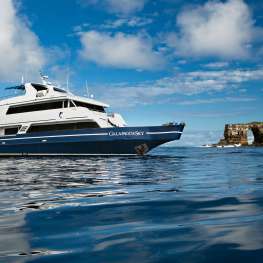
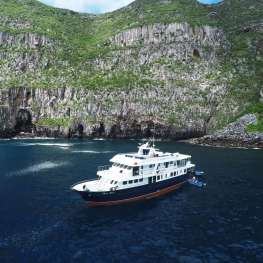
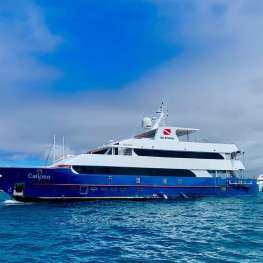
The Galápagos Islands span a vast area of ocean. The thirteen major islands and numerous smaller islets are spread across roughly 320 kilometres of Pacific Ocean, and the most important dive sites — Darwin Island and Wolf Island in the far north — are 180 kilometres from the nearest permanent human settlement. No land-based operation can reach these sites efficiently. The only practical way to experience the full range of Galápagos diving, including the northern islands that host the hammerhead aggregations and the largest whale shark concentrations, is aboard a liveaboard vessel permitted to operate within the Marine Reserve.
Day-boat diving is possible from the main inhabited islands — Santa Cruz, San Cristóbal, and Isabela — and provides access to a range of excellent local sites. But the Galápagos liveaboard experience is categorically different from the day-boat experience. A liveaboard itinerary covers the full geographic spread of the archipelago, reaching Darwin and Wolf in the north, Fernandina and Isabela in the west, and the central sites around Santa Cruz and the Gordon Rocks. It allows multiple dives per day at each site, including dawn dives — when the hammerhead schools at Darwin are at their most concentrated — and night dives that reveal the nocturnal behaviour of the sea lions, sharks, and invertebrate communities that inhabit the reef. A full 8-night liveaboard itinerary covers more diving ground than several weeks of day-boat operations.
Most Galápagos liveaboards carry between 12 and 16 divers. All operators within the Marine Reserve are required to hold Ecuadorian National Park permits, and the number of permitted vessels and diver visits to sensitive sites is strictly controlled. Naturalist guides — certified by the Galápagos National Park — accompany all dives and provide an ecological context to every encounter that transforms good diving into something closer to a field course in marine biology.
Key Dive Sites
Darwin's Arch is the site that defines the Galápagos diving experience and one of the most celebrated dive sites in the world. A natural rock arch — the last remnant of an eroded volcanic crater — sitting in open ocean at the northernmost point of the archipelago, Darwin's Arch rises from water that channels the cold, nutrient-dense Cromwell Current directly against the island's submerged foundations. The result is an aggregation of hammerhead sharks — scalloped hammerheads in schools of dozens to hundreds of animals — that rivals anything found at Cocos Island or Malpelo. Darwin's Arch is also the most reliable site in the Galápagos for whale shark encounters; from June to November, whale sharks pass through with extraordinary regularity, and sightings of multiple individuals in a single dive are recorded throughout the season. Galápagos sharks, silky sharks, and enormous schools of bigeye jacks complete a site that operates at a level of pelagic density that very few places on earth can match. Note: as of 2023, the arch formation itself collapsed naturally, but the dive site and its marine life remain unchanged and fully operational.
Wolf Island is Darwin's nearest neighbour and equally remarkable in its pelagic productivity. The main site — a series of submerged rocks and walls along the island's eastern and northern coast — produces consistently large hammerhead aggregations, whale shark sightings, and one of the most reliable sites in the world for Galápagos sharks in high density. Wolf is also the site where whale sharks in the Galápagos have been most extensively studied, and the research conducted here — revealing that the whale sharks visiting the northern Galápagos are overwhelmingly female and pregnant — has produced some of the most significant marine biology findings of the past two decades. Encountering a 12-metre female whale shark in open water at Wolf Island, knowing what the science says about why she is here, transforms the encounter from wildlife tourism into something closer to witnessing an ecological event.
Gordon Rocks is a collapsed volcanic crater near Santa Cruz and the most celebrated site in the central Galápagos, famous for its hammerhead shark aggregations and its genuinely challenging conditions. Three submerged pinnacles create powerful, converging currents that concentrate marine life in extraordinary density — hammerheads, Galápagos sharks, eagle rays, marble rays, and schools of pelagic fish that navigate the currents in tight formation. Gordon Rocks is not suitable for inexperienced divers; the currents can be severe, blue-water orientation is required, and conditions change rapidly with tidal state. For experienced divers, it is one of the most intense and rewarding dives in the central archipelago.
Cabo Douglas and Punta Espinoza (Fernandina Island) sit on the western edge of the archipelago, swept by the cold Cromwell Current and home to the highest density of marine iguanas in the Galápagos. Diving here means sharing the water with marine iguanas feeding on algae on the volcanic rock — a genuinely surreal encounter that exists nowhere else on earth — alongside Galápagos penguins hunting at speed, flightless cormorants pursuing fish across the seafloor, and Galápagos fur seals resting in caves along the wall. The diving here is cooler (19°C to 22°C), the visibility more variable due to plankton, and the endemic wildlife density is unlike any other site in the archipelago.
Kicker Rock (León Dormido), near San Cristóbal, is one of the most photogenic sites in the central Galápagos — two volcanic tuff towers rising dramatically from the ocean, with a narrow channel between them that funnels current and concentrates marine life. Hammerheads, Galápagos sharks, sea turtles, eagle rays, and large reef fish schools make Kicker Rock one of the most consistent day-dive destinations accessible from the central islands. It is more suitable for intermediate divers than Gordon Rocks, and the dramatic topography makes every dive visually striking even on days when the big animal action is quiet.
Cousin's Rock, near Santiago Island, is a shallow, sheltered site renowned for seahorses — including the endemic Galápagos seahorse — nudibranchs, frogfish, and the kind of macro life density that provides a deliberate counterpoint to the high-octane pelagic diving of the northern sites. Sea lions are ubiquitous. Galápagos sea turtles rest under ledges. The site rewards slow, attentive diving and is popular for photography.
Marine Life
The Galápagos marine ecosystem is biologically unique because three major ocean currents — the cold Humboldt Current from the south, the cold Cromwell Current from the west, and the warm Panama Current from the north — converge on the archipelago simultaneously. This convergence creates temperature stratification, nutrient upwellings, and productivity gradients that support an extraordinary diversity and density of marine species — including 23 species found nowhere else on earth.
Scalloped hammerhead sharks are present throughout the archipelago but aggregate in their largest concentrations at Darwin and Wolf islands in the north. Schools of dozens to hundreds of animals are the defining Galápagos pelagic experience during the cool season.
Whale sharks visit Darwin and Wolf islands from June to November with exceptional frequency. The whale sharks of the northern Galápagos are almost exclusively large, pregnant females — the largest individuals in the world, regularly measuring 10 to 14 metres — making these encounters with a specific, scientifically documented population rather than casual wildlife sightings.
Marine iguanas are the Galápagos's most distinctive endemic diver — an animal that exists nowhere else on earth and that behaves in the water with an otherworldly calm that makes every encounter feel prehistoric. They dive to feed on algae, sometimes to 12 metres, surfacing to warm themselves on the volcanic rock above.
Galápagos sea lions are the constant companions of every dive in the archipelago. Curious, fast, and entirely uninhibited, they interact with divers in ways that feel genuinely playful — approaching, circling, exhaling bubbles in your face, and engaging in acrobatic spirals that no dog or dolphin has ever managed to make feel this choreographed.
Galápagos penguins — the only penguin species found north of the equator — are present year-round at Fernandina, Isabela, and the western islands, moving underwater at speeds and with agility that make them one of the most startling animals to encounter while diving.
Mola mola (ocean sunfish), green sea turtles, eagle rays, golden rays, Galápagos sharks, silky sharks, whitetip reef sharks, moray eels, frogfish, Galápagos sea horses, and flightless cormorants complete a species list of endemic and pelagic animals that no other archipelago on earth can replicate.
Best Time to Dive the Galápagos
There are two seasons in the Galapagos Islands, however, they fade into each other so there is no strict dividing line but they can be generally characterized as :
The cool season (June to November)
Driven by the Humboldt and Cromwell currents, which bring cold, nutrient-rich water from the south and west. Water temperatures at depth can drop to 16°C to 20°C in the central and western islands, and plankton density increases — reducing visibility in some areas but driving the extraordinary biological productivity that makes this season the best for large pelagic animals. Hammerhead schools at Darwin and Wolf are at their largest and most concentrated. Whale shark frequency is at its annual peak, with June to October producing the most reliable multiple-individual sightings. Mola mola appear regularly. The cool season is challenging — cold water, reduced visibility in places, stronger currents — but is widely considered the most biologically intense period in the Galápagos.
The warm season (December to May)
Brings the Panama Current from the north, raising water temperatures to 22°C to 26°C in most areas, increasing visibility to 15 to 25 metres, and producing calmer sea conditions. Whale sharks are less frequent, but hammerheads remain present. The warmer water brings increased manta ray activity — particularly at Darwin and Wolf — and the sea lions are at their most playful during the warm season breeding and pupping period (December to March). Marine iguana and penguin encounters remain excellent year-round. The warm season is the most comfortable period for less experienced divers and for those prioritising visibility and endemic wildlife encounters over pelagic density.
For whale sharks specifically, June to October is the window — with August and September being the peak months at Darwin and Wolf.
For hammerheads, the cool season from June to November is the most productive, though aggregations at Darwin occur year-round.
For the most comfortable overall experience with excellent visibility and warm water, January to April offers the best conditions for a first visit.
Water Temperature and Visibility
Water temperature varies dramatically across the archipelago and by season. In the warm season, surface temperatures reach 24°C to 26°C across most sites; in the cool season, the western and central islands can drop to 16°C to 20°C at depth, while the northern islands (Darwin and Wolf) typically stay 2°C to 3°C warmer due to their position relative to the currents. A 5mm wetsuit is the minimum for warm-season diving; a 7mm with hood is strongly recommended for cool-season diving, particularly in the western islands.
Visibility ranges from 10 to 15 metres during plankton-dense cool-season upwelling periods to 20 to 25 metres during the warm season. Darwin and Wolf typically offer better visibility than the central and western islands due to the open-ocean setting and reduced plankton near the surface. The reduced visibility of the cool season is closely associated with the nutrient richness that drives large animal aggregations — the green water at Gordon Rocks or Darwin is the same condition that brings the hammerheads.
Diving Conditions
Galápagos diving spans a wide range of conditions and is appropriate for a corresponding range of experience levels — but the most celebrated sites require significant experience.
Gordon Rocks, Darwin's Arch, and Wolf Island are advanced sites requiring a minimum of Advanced Open Water certification with 50+ logged dives and prior experience in strong currents and blue-water orientation. The currents at Gordon Rocks can exceed 3 knots and change direction rapidly; the open-water blue descents at Darwin require composure and buoyancy control that inexperienced divers find challenging.
Sites such as Kicker Rock, Cousin's Rock, and the sheltered bays around Santa Cruz and San Cristóbal are accessible to confident Open Water divers with 20 to 30 logged dives and are suitable for those visiting the Galápagos on their first liveaboard itinerary.
Most liveaboard operators offer a range of dives at both levels within the same itinerary, allowing less experienced divers to participate fully while the advanced divers push to the more demanding sites. Pre-trip briefings and dive guides are uniformly thorough on responsible Galápagos liveaboards — the National Park framework requires it.
An SMB is mandatory on all open-water dives. Currents can surface-separate divers from the group rapidly at sites like Gordon Rocks and Darwin; the protocol for managing separation should be confirmed with the dive guide before every entry. Seasickness medication is recommended for the longer passages between island groups, particularly during the cool season.
Please Note : Galapagos is an advanced diving destination due to its strong currents, varying visibility and cold water. Divers must be comfortable in these conditions, as well as have very good buoyancy and be able to do negative (sometimes rapid) back-roll entries/descents from small boats.
Recommended requirements are : 50 -100 open water dives, experience in currents, ability in removing gear in water and ability in getting into small boats in choppy seas.
All divers should have Nitrox certification. Divers without Nitrox certification will not be able to complete all dives on the 3 days spent at Wolf and Darwin islands due to depths and time lengths of dives and recreational non-decompression limits. Or you will risk to miss a few dives.
Who Is the Galápagos For?
The Galápagos is the rare dive destination that genuinely delivers something for every serious diver — from the first-time liveaboard passenger encountering a barrel-rolling sea lion at a central island site to the veteran pelagic hunter positioned in the thermocline at Darwin's Arch with a hundred hammerheads turning overhead.
What separates the Galápagos from every other destination in the eastern Pacific is the combination. Cocos Island and Socorro Islands offer more extreme and single-minded pelagic encounters — higher densities of a smaller number of species in more challenging conditions. The Galápagos offers pelagic encounters of the same quality at the northern islands while simultaneously delivering a breadth of endemic marine and terrestrial wildlife — the iguanas, the penguins, the sea lions, the flightless cormorants — that no other Pacific island system can approach. It is simultaneously one of the world's best shark-diving destinations and one of the world's most extraordinary wildlife experiences, and it is the only destination on earth where a single liveaboard itinerary can deliver both without compromise.
It is also a destination of profound ecological significance. Every dive in the Galápagos takes place within a protected ecosystem that is being actively monitored, managed, and studied. The naturalist guides who accompany every dive bring a layer of scientific and ecological context that transforms encounters from spectacle into understanding. Divers who arrive looking for an Instagram-calibre shark encounter often leave with something that feels more like a conversion experience.
Practical Information
The Galápagos Islands are reached via Quito or Guayaquil in mainland Ecuador, with flights to either Baltra Island (GPS airport, near Santa Cruz) or San Cristóbal Island (SCY airport). Most liveaboards depart from Puerto Ayora on Santa Cruz or Puerto Baquerizo Moreno on San Cristóbal; operators provide detailed embarkation instructions and typically arrange or recommend airport transfers.
All visitors to the Galápagos must pay a National Park entrance fee (currently USD $200 for foreign nationals at time of writing (2026) — verify the current fee before travel, as this has increased in recent years) upon arrival at the airport. A Transit Control Card (TCT) is also required and is handled at the Ecuadorian mainland airport before departure. These requirements are non-negotiable and apply to all liveaboard guests without exception.
Nitrox is available on all current Galápagos liveaboards. A 5mm wetsuit is minimum; 7mm with hood is recommended for cool season and western island diving. An SMB and dive computer are mandatory. A dive light is useful for cave dives and ledge inspections.
The nearest recompression chamber is in Guayaquil on the mainland — a significant distance. Dive insurance with emergency medical evacuation coverage is strongly recommended and should be confirmed active before departure.
Browse Galápagos liveaboards on Dive and Cruise
Frequently Asked Questions
Do I need to be an advanced diver to dive the Galápagos?
Not for all sites. Central island sites such as Kicker Rock, Cousin's Rock, and the bays around Santa Cruz are accessible to confident Open Water divers with 20 to 30 logged dives. The northern sites — Darwin's Arch and Wolf Island — are advanced dives requiring experience with strong currents, blue-water orientation, and a minimum of 50 logged dives. Most liveaboard itineraries include both types of site, and dive guides assess each diver's suitability site-by-site during the trip.
What is the best site for whale sharks?
Darwin Island and Wolf Island in the far north of the archipelago are the most reliable whale shark sites in the Galápagos. The peak season is June to October, with August and September producing the highest frequency of encounters. Whale sharks here are overwhelmingly large pregnant females — some of the biggest individuals on record — and the encounters tend to be open-water, blue-pelagic experiences rather than reef-associated.
How does the Galápagos compare to Cocos Island and Socorro Islands?
All three are considered among the world's top pelagic dive destinations, and all require liveaboard access. Cocos Island offers the highest concentration of scalloped hammerheads and the most extreme shark-diving conditions. Socorro Islands offers unrivalled interactive manta ray encounters and humpback whale experiences. The Galápagos offers the broadest overall experience — comparable pelagic quality at the northern islands combined with extraordinary endemic wildlife diversity across the full archipelago. Of the three, the Galápagos is the most accessible to a range of experience levels; Cocos and Socorro are more consistently demanding.
What is the National Park fee and do I need to pre-arrange it?
As of 2024, the Galápagos National Park entrance fee for foreign nationals is USD $200, paid upon arrival at the airport in the islands. A Transit Control Card is also required and issued at the mainland Ecuadorian airport before departure — this is arranged through the airline check-in process. Your liveaboard operator will provide full instructions. The fees are mandatory for all visitors and cannot be waived or pre-paid online.
Is the Galápagos suitable for non-diving partners?
Unusually among remote liveaboard destinations, the Galápagos is genuinely rewarding for non-divers travelling with a diving partner. The above-water wildlife — giant tortoises, land iguanas, Darwin's finches, blue-footed boobies, frigatebirds — is extraordinary in its own right, and the National Park naturalist guides provide context that enriches the topside experience considerably. Snorkelling in the Galápagos is also exceptional, with sea lions, marine iguanas, penguins, and sea turtles accessible at many sites in shallow water. Confirm with your operator that the vessel accommodates non-diving guests before booking.
Part of Ecuador · Americas & Caribbean · Browse Galápagos liveaboards on Dive and Cruise