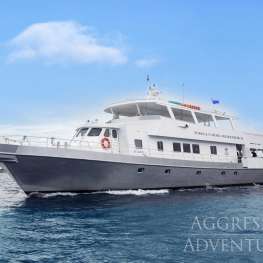
Off the coast of Central America, protected by the longest barrier reef in the northern hemisphere and the second-longest in the world, Belize offers a marine environment of extraordinary diversity and integrity. The Belize Barrier Reef runs for nearly 300 kilometres along the country's Caribbean coast, and together with its three offshore atoll systems — Turneffe Atoll, Lighthouse Reef, and Glover's Reef — it forms a UNESCO World Heritage Site of staggering ecological complexity: patch reefs, mangrove cayes, seagrass meadows, deep-water walls, atoll lagoons, and the geological wonder that has made Belize internationally famous among divers — the Great Blue Hole.
Belize punches above its weight as a diving destination. It is neither the most remote nor the most pelagic of the Caribbean's options, but it is arguably the most varied. A liveaboard week in Belize can deliver a dive into the Great Blue Hole's stalactite cavern, a drift along the wall at Half Moon Caye with a hundred-strong school of eagle rays, an afternoon on a shallow patch reef in the lagoon where nurse sharks sleep in the coral heads, a night dive on an outer atoll wall alive with octopus and Spanish lobster, and a morning snorkel session with whale sharks off Gladden Spit — all within the geography of the reef system and its offshore atolls. The breadth is genuine and the quality at each end of the spectrum is exceptional.
Belize is also among the most consciously protected marine environments in the Central American Caribbean. The government of Belize has designated a significant proportion of its reef system as marine protected areas, and enforcement — relative to many comparable reef systems — is meaningful. The result is a reef ecosystem that, while under pressure from warming and bleaching like all tropical reefs, retains a structural integrity and large-animal abundance that distinguish it from the more heavily exploited reefs of the broader Caribbean.
Why Dive Belize by Liveaboard
The Belize reef system is geographically extensive. The atolls — Turneffe, Lighthouse Reef, and Glover's Reef — lie between 30 and 80 kilometres offshore, and the distance between the northernmost and southernmost diving areas of interest exceeds 200 kilometres. No single land-based operation can efficiently access more than one or two sections of this geography. A liveaboard is the only practical way to experience the full range of Belize diving — the Great Blue Hole at Lighthouse Reef, the whale shark aggregation at Gladden Spit in the south, the pristine atoll diving of Glover's Reef, and the richest sections of the barrier reef — in a single itinerary.
The offshore atolls in particular are accessible only by extended boat passage from the mainland. Turneffe Atoll, the largest atoll in the Caribbean, sits 30 kilometres offshore and requires a 2 to 3-hour passage from Belize City. Lighthouse Reef, home to the Great Blue Hole, is a further 30 kilometres beyond Turneffe. Glover's Reef, the most remote and biologically pristine of the three, sits 45 kilometres offshore in the open Caribbean. A liveaboard can anchor in the lee of any of these atolls and access their full diving geography — from the shallow lagoon patch reefs to the deep outer walls — without returning to shore.
Most Belize liveaboards carry 16 guests and operate itineraries of 7 to 10 nights, typically combining the Great Blue Hole with extensive atoll and barrier reef diving. Shorter 4 to 5-night itineraries focused on Turneffe and Lighthouse Reef are available for divers with limited time. The combination of diving, snorkelling, above-water wildlife (the caye forests support significant seabird, frigate bird, and red-footed booby populations), and the natural beauty of the atoll environments makes Belize liveaboards genuinely rewarding for mixed groups of divers and non-divers.
Key Dive Sites
The Great Blue Hole is the most famous dive site in Belize and one of the most iconic in the world — a perfectly circular marine sinkhole 300 metres across and 125 metres deep, visible from space as a dark disc in the turquoise of Lighthouse Reef's lagoon, and brought to global attention by Jacques Cousteau in 1971. The dive is not a wildlife encounter — the Blue Hole's deep, still water is low in nutrients and supports limited marine life. What it is, instead, is a geological spectacle of rare magnificence: a descent through increasingly clear water to a ceiling of enormous stalactites at 25 to 30 metres, hanging in perfect formation from a cavity formed when the limestone cave system above collapsed into the sea during the last ice age. The stalactites are among the largest and most pristine in any accessible underwater cave system — some exceed 12 metres in length — and the scale of the cavern, the clarity of the water, and the quality of the light at depth create a visual environment that justifies the Blue Hole's status as a bucket-list dive for a significant portion of the diving world.
The dive is conducted as a guided descent to the stalactite level (approximately 30 to 40 metres), a brief period of observation, and a slow ascent with a safety stop. Marine life is limited to a few Caribbean reef sharks, the occasional bull shark in the deeper water, and the amberjacks and midnight parrotfish that circle the entrance. The dive is the setting, not the species.
Half Moon Caye Wall is the Great Blue Hole's companion site at Lighthouse Reef and, for many divers, the more immediately rewarding of the two. The outer wall of Half Moon Caye drops from a shallow coral terrace to beyond 40 metres in a near-vertical drop covered with enormous sponge formations, black coral trees, and a dense community of large reef fish. Schools of horse-eye jacks, blacktip reef sharks, and eagle rays drift along the wall face. A dense population of nesting red-footed boobies and magnificent frigatebirds occupies the caye's interior forest — one of the largest nesting colonies in the Western Caribbean — and the combination of the wall diving quality and the above-water wildlife makes Half Moon Caye one of the most complete natural experiences in Belize.
Turneffe Atoll is the largest atoll in the Caribbean and the closest to Belize City, making it the most commonly visited of the three offshore atolls on Belize liveaboard itineraries. Its outer walls, drop-offs, and the famous Elbow — a promontory on the southeastern tip of the atoll where strong currents converge and create one of the most reliably productive drift dives in Belize — offer a range of diving from shallow coral gardens to deep wall encounters. The Elbow is famous for its eagle ray encounters: schools of spotted eagle rays in their dozens are regularly encountered on strong current days, circling the point in formation before dispersing into the blue. Caribbean reef sharks are present throughout the atoll in good numbers, and the atoll's interior lagoon provides sheltered snorkelling and shallower diving with abundant reef fish and juvenile sharks.
Gladden Spit is a promontory on the outer barrier reef south of Placencia where a remarkable seasonal event occurs: from March through June, whale sharks aggregate offshore to feed on the spawn of cubera snapper and other reef fish during the full moon cycle. The spawning aggregations attract whale sharks in numbers that can reach ten or more individuals simultaneously — feeding at or near the surface in a density of fish spawn that turns the water milky white. The Gladden Spit whale shark encounter is one of the most extraordinary seasonal wildlife events in the Caribbean and is available exclusively to those who time their visit to coincide with the full moon spawning windows between March and June.
Glover's Reef is the most remote and the most biologically pristine of the Belizean atolls — a UNESCO World Heritage Site whose isolation from the mainland has allowed its reef ecosystem to develop to a structural and biological complexity that the more accessible atolls cannot fully match. The outer walls of Glover's Reef drop into some of the deepest water in the Caribbean Sea, and the combination of deep wall diving, large-animal encounters, and the extraordinary visibility of the outer reef produces some of the finest diving in Belize. Nassau grouper spawn at Glover's Reef in aggregations that have been documented for research purposes; the reef's coral coverage and structural complexity are among the best preserved in the region.
The Belize Barrier Reef proper — the shallow and mid-depth reef structures running along the coast between the mainland and the atolls — provides more accessible, generally shallower diving with high biodiversity. Coral gardens, swim-through tunnels, patch reefs surrounded by seagrass meadows, and a consistent abundance of turtles, rays, nurse sharks, and reef fish make the inner barrier reef ideal for less experienced divers and for the quieter, more exploratory dives that balance an itinerary otherwise dominated by the deeper atoll sites.
Marine Life
Belize's marine ecosystem supports the full community of a healthy, largely intact Caribbean reef system. While Caribbean reefs broadly have suffered significant declines in coral cover and fish biomass over the past five decades, the Belizean reef — particularly the offshore atolls and the UNESCO-designated zones — retains an abundance and structural diversity that is genuinely unusual in the modern Caribbean.
Whale sharks visit Gladden Spit from March to June, drawn by the spawning aggregations of snapper, grouper, and other reef fish during full moon periods. This is the most reliable whale shark encounter in the Caribbean — not the open-ocean blue-water encounters of the Indo-Pacific or eastern Pacific, but shallow, near-reef feeding encounters that allow extended snorkel and dive time with animals feeding at or near the surface.
Caribbean reef sharks are present at all atoll sites in good numbers and at the Elbow and Half Moon Caye Wall in particular densities. Their ambient presence throughout the Belizean reef makes every dive feel engaged with the larger ecological community of the reef.
Bull sharks are encountered in the deeper sections of the atolls and in the Blue Hole. The southern barrier reef and the area around Gladden Spit in particular have a resident bull shark population. Nurse sharks are abundant across the system — sleeping under coral heads, resting on sandy patches, and aggregating around certain rocky outcrops in numbers that give even beginner divers consistent close encounters.
Spotted eagle rays are common throughout the atolls and aggregations of dozens are regularly encountered at the Elbow, Turneffe. Southern stingrays rest on sandy patches everywhere. Green sea turtles and hawksbill turtles are present at every site.
Nassau grouper and black grouper — heavily depleted throughout the Caribbean — are present in greater numbers in Belize than in most comparable regions, a function of the marine protected area system and the documented spawning aggregations at Glover's Reef and elsewhere.
Dolphins, West Indian manatees (in the mangrove lagoons of the cayes), and American crocodiles (in the mangrove channels) complete a species list that extends well beyond the reef itself.
Best Time to Dive Belize
Belize is a year-round diving destination, with conditions varying modestly by season and more significantly by specific site and weather system.
March to June is the optimal window for the Gladden Spit whale shark experience, which is timed to the full moon spawning aggregations of cubera snapper. The whale sharks appear most reliably in the two to four days around each full moon from March through June, peaking in April and May. This window also represents the tail end of the dry season, with settled conditions and good visibility throughout the reef system.
November to April is the dry season, with generally calmer sea conditions, the lowest rainfall, and the best visibility across the system — typically 20 to 30 metres at the atolls and on the outer barrier reef. Water temperatures are at their coolest during this period, ranging from 24°C to 27°C. This is the most popular window for first-time Belize liveaboard visitors and for those prioritising the Great Blue Hole and atoll diving.
May to October is the rainy season, with more variable conditions, higher humidity, and the possibility of tropical weather systems from August through October. Water temperatures rise to 28°C to 30°C, visibility can be reduced during plankton bloom periods, and some liveaboard operators limit or suspend operations during peak hurricane season (September to October). Outside of storm events, the rainy season offers excellent diving with fewer visitors, warmer water, and increased biological activity.
For the most complete Belize liveaboard experience — whale sharks at Gladden Spit, Great Blue Hole, Half Moon Caye, Turneffe Elbow, and Glover's Reef — April to May is the single optimal window, combining the whale shark peak with the tail end of dry-season conditions.
Water Temperature and Visibility
Water temperature at the atolls and outer reef ranges from 24°C to 27°C in the dry season (November to April) to 27°C to 30°C in the rainy season (May to October). A 3mm wetsuit is sufficient for most of the year; a 5mm is comfortable during the coolest months of January through March, particularly for multiple-dive days.
Visibility is excellent at the offshore atolls and outer reef — typically 20 to 30 metres in good conditions and up to 40 metres at the outer walls of Glover's Reef and Lighthouse Reef during the dry season. Inner barrier reef visibility is more variable, influenced by sediment from the mainland rivers during rainy season and by the productivity of the lagoonal waters. The Great Blue Hole itself offers exceptional clarity at depth — the deeper you go, the clearer it becomes — due to the stratified, still water of the sinkhole.
Diving Conditions
Belize diving spans a wide range of site difficulty, from genuinely beginner-accessible reef gardens to the more demanding walls of the outer atolls and the depth of the Blue Hole.
Inner barrier reef and atoll lagoon sites — shallow coral gardens, patch reefs, mangrove channels — are accessible to Open Water divers with 15 to 20 logged dives. Currents are minimal, depths are shallow, and the biodiversity is high.
Outer atoll walls and the Half Moon Caye Wall involve some current and greater depths (to 30+ metres). Advanced Open Water with 30+ logged dives and some wall-diving experience is the sensible recommendation.
The Great Blue Hole requires Advanced Open Water certification due to the depth (the stalactite zone is at 30 to 40 metres) and the overhead environment of the cavern. The dive is not technically demanding in terms of current — the Blue Hole is essentially still — but the depth and the enclosed setting require the experience and buoyancy control of Advanced certification. Responsible operators enforce this requirement without exception.
The Elbow at Turneffe can involve strong currents on the ebb tide; drift diving experience and the ability to manage a controlled blue-water drift are important. The current can be powerful enough to make station-keeping difficult without experience, and novice divers should approach this site with realistic expectations.
Gladden Spit whale shark dives are conducted as shallow water encounters (typically 10 to 20 metres) in the open water above the reef. Some current is common, and the presence of feeding whale sharks requires calm, directional swimming in open water. Open Water with 20+ logged dives is the standard minimum.
Who Is Belize For?
Belize is for the diver who wants the most varied and complete Caribbean diving experience available, delivered in a setting of genuine natural beauty and within a marine environment that retains more of the ecological integrity of a pre-exploitation Caribbean reef than almost any comparable destination in the region.
The Great Blue Hole alone justifies a Belize trip for many divers — it is one of the most distinctive natural dive sites on earth and a genuinely singular visual experience. But the Blue Hole is the beginning of the Belize story rather than the entirety of it: the whale sharks at Gladden Spit, the eagle ray aggregations at the Elbow, the wall diving at Glover's Reef, the turtle encounters at every site, the nurse shark abundance, and the general quality of the reef ecosystem that the atoll system presents are each individually outstanding.
For divers who have concentrated their experience in the Pacific — in Socorro Islands, Cocos Island, or the Galápagos — Belize offers a completely different kind of diving: warmer, shallower, more coral-rich, more about the reef ecosystem as a whole than about specific pelagic species. It is not less extraordinary; it is differently extraordinary.
Belize is also one of the better liveaboard destinations for mixed groups — divers and non-divers, experienced and beginner — because the range of site difficulty is genuinely wide, the above-water wildlife is exceptional (particularly at Half Moon Caye), and the visual beauty of the caye and atoll environment rewards simply being present, whether or not you are underwater.
Practical Information
Belize City is the main entry point, served by Philip S.W. Goldson International Airport (BZE) with direct connections from Miami, Houston, Dallas, Atlanta, Charlotte, and other US cities. Most liveaboard operators depart from Belize City harbour or from marine terminals near the international airport; some operators base their vessels at Placencia in the south for itineraries focused on Gladden Spit and southern reef sites. Operators provide transfer logistics from the airport to the embarkation point.
Standard itineraries run 7 to 10 nights for full coverage of the Great Blue Hole, Turneffe, Half Moon Caye, and Glover's Reef. Shorter 4 to 5-night itineraries cover Lighthouse Reef and Turneffe. Gladden Spit whale shark itineraries (March to June) are typically 5 to 7 nights and are timed to the full moon cycle; confirm the exact moon dates for your target months before booking.
Nitrox is available on most current Belize liveaboards. A 3mm wetsuit is standard; a 5mm is recommended for January through March. An SMB is mandatory for all open-water ascents, particularly on the outer atoll walls where surface currents may separate divers from the vessel.
A recompression chamber is operated by the Belize Hyperbaric Centre in Belize City. Dive insurance with emergency medical coverage is strongly recommended.
Browse Belize liveaboards on Dive and Cruise
Frequently Asked Questions
Is the Great Blue Hole worth it as a dive?
This is the most commonly asked question about Belize diving, and the honest answer is: it depends entirely on what you want from a dive. The Great Blue Hole is not a marine life encounter — it is a geological spectacle, and one of genuine magnificence. The stalactites at 30 metres are among the most impressive formations in any accessible underwater cave system, and the descent through increasingly clear water into the cavern is a genuinely extraordinary experience. If you are visiting Belize primarily for reef fish diversity, shark encounters, or coral ecology, the Blue Hole will not be your highlight — the marine life is limited. If you are visiting Belize specifically for the visual and geological experience of diving a 125-metre sinkhole with stalactites the size of trees, the Blue Hole will exceed expectations. For most divers, it is an essential experience that earns its reputation, even if the adjacent wall diving at Half Moon Caye is biologically richer.
When is the best time to see whale sharks at Gladden Spit?
Whale sharks at Gladden Spit are triggered by the spawning aggregations of cubera snapper and other reef fish, which occur in the two to four days around each full moon from March through June. April and May are the most reliable months for multiple whale shark sightings. The encounter requires precise timing — arriving within two to three days of the full moon — so itineraries targeting the whale sharks should be booked specifically around the lunar calendar. Your liveaboard operator will provide exact dates for each full moon window within the season.
How does Belize diving compare to other Caribbean liveaboard destinations?
Belize offers the most geographically complete Caribbean liveaboard experience — the Great Blue Hole, offshore atolls, seasonal whale sharks, and one of the most intact barrier reef systems in the Caribbean. Compared to the Bahamas, Belize offers more reef variety and the Blue Hole but fewer concentrated shark encounters. Compared to the Exuma Cays, Belize is more remote, more atoll-focused, and offers the whale shark experience. For divers whose primary goal is a single extraordinary species encounter — tiger sharks, great hammerheads — the Bahamas delivers more reliably. For divers who want the broadest possible Caribbean reef experience in a single trip, Belize is the answer.
Part of Americas & Caribbean · Browse Belize liveaboards on Dive and Cruise