Indonesia is the undisputed liveaboard diving capital of the world. Straddling the equator across more than 17,000 islands, this vast archipelago sits at the heart of the Coral Triangle — a region recognised by marine scientists as the global epicentre of ocean biodiversity. Indonesia is home to over 3,000 species of fish, 76% of the world's known coral species, and a staggering array of marine megafauna: from manta rays and whale sharks to pygmy seahorses and walking sharks found nowhere else on earth.
What sets Indonesia apart is sheer variety. No other destination on earth allows a diver to experience such contrasting underwater environments within a single itinerary. Drift through nutrient-charged channels in Komodo, hover over coral-encrusted seamounts in Raja Ampat, explore black-sand muck diving in Sulawesi, or drift above ancient soft coral forests in the remote Banda Sea. Whether you are chasing schooling hammerheads, rare critters, whale sharks, or simply the most pristine reefs on the planet, Indonesia delivers.
Indonesia's diving is accessible year-round, with each region peaking at different times, meaning there is always somewhere exceptional to dive regardless of the season.
Why Dive Indonesia by Liveaboard
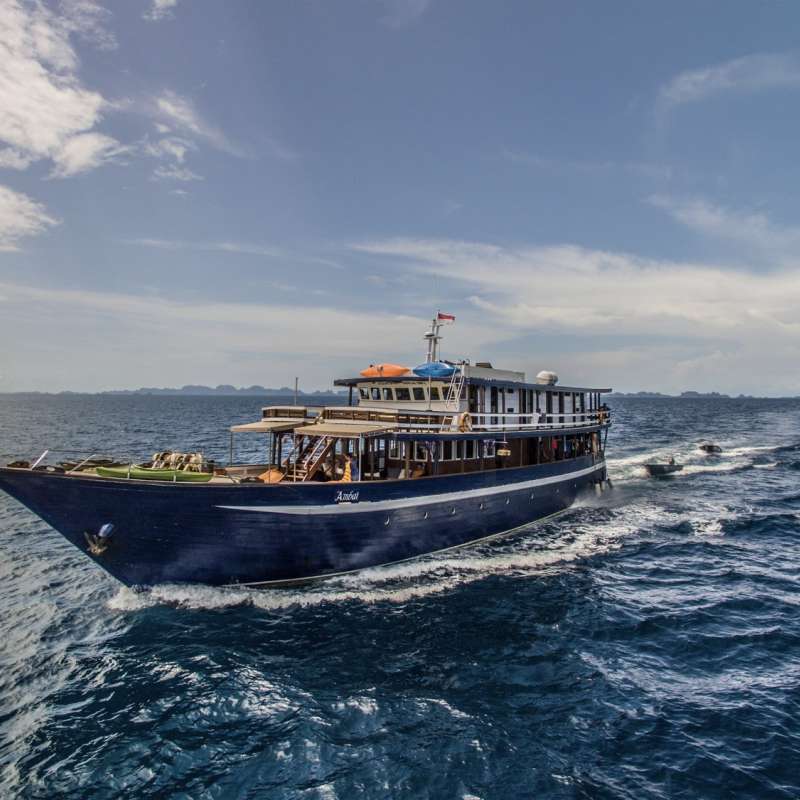
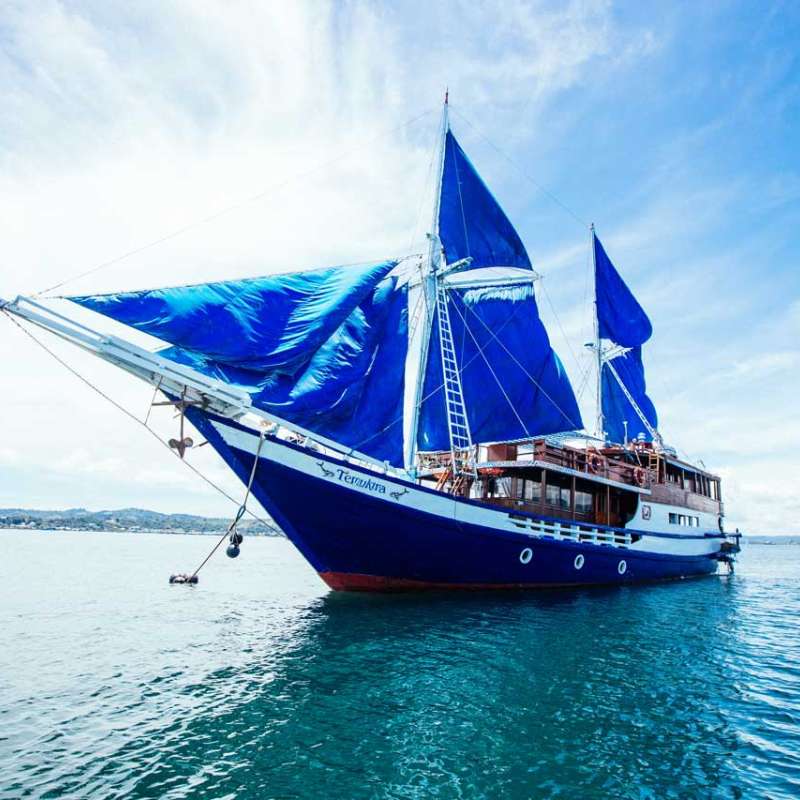
Indonesia's greatest dive sites share one common trait: they are remote. Raja Ampat's best reefs lie scattered across hundreds of uninhabited islands. Banda Sea seamounts rise from deep ocean far from any port. Triton Bay and Cenderawasih Bay require multi-day passages to reach. For any serious diver, a liveaboard is not just the preferred way to explore Indonesia — it is the only practical way to reach the sites that matter most.
Indonesia Liveaboard Quick Facts
Indonesia liveaboards typically offer 3 to 5 dives per day, including possible sunset/night dives. Water temperature ranges from 26°C to 30°C across most regions, with thermoclines possible in the Banda Sea and deeper sites. Visibility varies widely by region and tidal cycle, from 10 metres in nutrient-rich muck diving areas to 40 metres or more at offshore seamounts. Most liveaboards carry nitrox as standard or available for a supplement. A 3mm wetsuit is sufficient for most regions; a 5mm is recommended for the Banda Sea and deeper dives. The main departure hubs for Indonesia liveaboards are Bali (DPS), Sorong (SOQ), Manado (MDC), and Labuan Bajo (LBJ).
Liveaboard Diving Regions :

Indonesia's liveaboard routes are organised by region, each with a distinct character, signature marine life, and optimal season. Below is a summary of all 11 regions. Click through to each destination page for full dive site details, seasonal guides, and liveaboard recommendations.
Raja Ampat
Located at the northwestern tip of West Papua, Raja Ampat is widely considered the most biodiverse marine environment ever recorded. Hundreds of jungle-covered limestone islands rise from shallow turquoise seas, and every reef surface is carpeted in hard and soft corals competing for space. The region is renowned for its extraordinary reef fish diversity — more species have been recorded here per square metre than anywhere on the planet — as well as whale shark encounters, manta ray cleaning stations, and endemic species including the wobbegong carpet shark and epaulette walking shark. Diving style ranges from gentle drift on incoming tides to more challenging channel crossings, suiting a wide range of experience levels. Best season: October to April.
Komodo
Komodo National Park, a UNESCO World Heritage Site in East Nusa Tenggara, is where the Indian Ocean and Banda Sea collide — generating some of Indonesia's most thrilling drift diving. Strong, nutrient-rich currents surge through narrow channels between the islands, driving a pelagic food chain that attracts manta rays, reef sharks, schools of fish in the hundreds of thousands, and regular sightings of the ocean sunfish (mola mola) from late July onwards. Above the waterline, Komodo and Rinca islands are the only places on earth where Komodo dragons still roam wild. This is a destination for divers who want big fish, big currents, and big drama. Best season: April to November.
Banda Sea
The Banda Sea is Indonesia's great frontier — a remote, deep-ocean wilderness encircling the historic Spice Islands that very few divers ever reach. Because it requires a multi-day liveaboard passage from either Sorong or Ambon, the sites here remain almost entirely unvisited, and the rewards are extraordinary. Seamounts rise from abyssal depths, attracting hammerhead sharks, blue-water pelagics, and dense schools of barracuda. Reef walls drop vertically hundreds of metres, draped in pristine black coral and gorgonian sea fans. For experienced liveaboard divers seeking true exploration diving, the Banda Sea delivers experiences that feel genuinely undiscovered. Dive season: October to May.
Alor
Tucked between the Flores Sea and the Sawoe Sea in the eastern arc of Nusa Tenggara, Alor Archipelago is one of Indonesia's best-kept diving secrets. The volcanic geology creates dramatic underwater topography — vertical walls, ridges, and pinnacles smothered in soft corals — while converging currents from multiple directions deliver exceptional biodiversity. Alor is particularly celebrated for its muck diving in Kalabahi Bay, where black volcanic sand conceals frogfish, mimic octopus, and rhinopias. Open-water sites bring reef sharks, mola mola, and eagle rays. This is off-the-beaten-path diving at its most rewarding, ideal for divers who want diversity without the crowds. Best season: May to November.
Wakatobi
Wakatobi Marine National Park in Southeast Sulawesi is Indonesia's answer for divers who value coral health above all else. Protected since the 1990s, the reefs here are among the most intact in the entire region, with over 850 species of coral recorded and visibility that routinely exceeds 30 metres. The calm seas and gentle conditions make Wakatobi ideal for underwater photographers, macro hunters, and divers who want to slow down and study every centimetre of the reef. Leaf scorpionfish, pygmy seahorses, ribbon eels, and nudibranchs are permanent residents. The absence of heavy currents also makes it one of the most accessible regions for less experienced liveaboard divers. Best season: April to December.
Sulawesi
Sulawesi — and in particular the waters around Lembeh Strait and Bunaken Marine Park — occupies a unique position in the diving world. Lembeh Strait is universally acknowledged as the global capital of muck diving: a black-sand underwater jungle teeming with the most bizarre and rare critters on the planet, including hairy frogfish, flamboyant cuttlefish, blue-ringed octopus, mimic octopus, Ambon scorpionfish, and dozens of nudibranch species found nowhere else. Bunaken, by contrast, offers spectacular wall diving and healthy reef fish populations. A liveaboard combining both areas within a single itinerary offers a genuinely unbeatable range of dive experiences. Best season: May to October.
Triton Bay
Triton Bay, on the southwestern coast of West Papua, is one of Indonesia's most recently explored dive destinations — a remote system of bays, islands, and narrow channels that feels more like an untouched wilderness than an established diving circuit. Often called the "Lost World of West Papua", Triton Bay is celebrated for its extraordinary density of soft corals, its populations of whale sharks that gather around traditional fishing platforms called bagans, and its remarkable macro life including the elusive flasher wrasse. Cold, nutrient-rich upwellings create near-perfect conditions for wide-angle photography and big-animal encounters in the same dive. Best season: October to April.
Cenderawasih Bay
Cenderawasih Bay, a vast protected bay on the northern coast of West Papua, is home to one of the world's most reliable and extraordinary wildlife encounters: resident whale sharks. Unlike seasonal aggregations found elsewhere in the world, Cenderawasih's whale sharks are present year-round, drawn by the bagan fishing platforms where local fishermen have protected these gentle giants for generations. Diving or snorkelling alongside multiple whale sharks simultaneously, in calm and sheltered waters, is an experience that puts Cenderawasih Bay on every serious wildlife diver's bucket list. The bay also offers pristine coral reefs, healthy shark populations, and excellent macro diving along its undisturbed walls. Best season: year-round; peak October to April.
Halmahera
Halmahera, the largest island in the Maluku (Moluccas) group, sits north of the Banda Sea and remains one of Indonesia's most underexplored dive regions. The waters surrounding this irregularly shaped island benefit from the convergence of currents from the Pacific Ocean and the Banda Sea, producing exceptional visibility and a diverse mix of pelagic and reef species. Halmahera is gaining recognition among dedicated liveaboard divers for its pristine, uncrowded reefs and its position on longer expedition routes connecting the Banda Sea with Raja Ampat. Volcanic geography creates striking underwater formations, and the region offers increasingly reliable thresher shark encounters at cleaning stations. Best season: October to May.
Derawan Islands
The Derawan Islands, off the northeastern coast of Borneo in East Kalimantan, are best known for two extraordinary encounters that are difficult to find reliably elsewhere. The islands host large nesting populations of green and hawksbill turtles, making turtle encounters on virtually every dive a near certainty. Kakaban Island's marine lake — a body of water disconnected from the ocean for thousands of years — is home to millions of stingless jellyfish that have evolved in total isolation, allowing divers to float freely among them without any risk. Beyond these headline experiences, Derawan also offers excellent muck diving, regular manta ray sightings, barracuda schools, and healthy coral gardens. Best season: April to October.
Sumbawa
Sumbawa, the large island immediately east of Lombok, is perhaps the most overlooked destination in the Nusa Tenggara chain. Positioned between the well-known sites of Komodo to the east and Bali to the west, it is frequently included as a transition stop on Bali–Komodo liveaboard routes — but it deserves attention in its own right. Highlights include the Moyo Island marine reserve, known for healthy reef shark populations and excellent coral coverage, and Sangeang Island, an active volcano where underwater volcanic activity creates unique dive conditions including warm, bubbling gas vents on the seabed. The region also attracts manta rays and offers rewarding muck diving in sheltered bays. Best season: May to November.
How to Choose Your Indonesia Liveaboard Route
With 11 distinct diving regions, choosing an Indonesia liveaboard itinerary can feel overwhelming. Here is a simple guide by diver type:
First-time Indonesia liveaboard divers should consider Komodo for big fish and iconic landscapes, or Raja Ampat for sheer biodiversity and colour. Both are widely served by liveaboards of all price points and offer experiences that justify the long-haul journey.
Macro and muck diving specialists will find their heaven in Sulawesi / Lembeh or Alor, where critter diversity is unlike anywhere else on the planet.
Wildlife encounter seekers looking for whale sharks should head to Cenderawasih Bay for year-round resident populations, or Triton Bay for a combination of whale sharks and extraordinary soft coral scenery.
Coral photography enthusiasts will be rewarded most in Wakatobi, where visibility is exceptional and the reefs are protected and intact.
Expedition divers seeking truly remote, uncrowded diving should explore Banda Sea or Halmahera, where liveaboard itineraries combine multiple island groups into journeys of genuine discovery.
Divers interested in unique wildlife beyond the reef — nesting turtles, jellyfish lakes, and manta rays — will find Derawan Islands delivers experiences found nowhere else in Indonesia.
Not sure which region fits you best? Contact our liveaboard specialists for personalised advice — we've dived them all.
Frequently Asked Questions
When is the best time to dive Indonesia by liveaboard?
There is no single best time — each region peaks at a different time of year. Raja Ampat and West Papua regions are best from October to April; Komodo and Nusa Tenggara are best from April to November; the Banda Sea is best from October to May. This means there is exceptional diving somewhere in Indonesia in every month of the year.
Do I need to be an advanced diver to dive Indonesia?
It depends on the region. Wakatobi and the Derawan Islands are suitable for Open Water certified divers. Komodo and the Banda Sea require Advanced Open Water certification and comfort with strong currents. Lembeh and Alor are not technically demanding but reward divers who have good buoyancy control and experience finding small critters. Each region page on Dive and Cruise includes a recommended experience level.
Is nitrox available on Indonesia liveaboards?
Yes — the majority of mid-range and premium Indonesia liveaboards offer nitrox as standard or for a supplement. Check individual boat profiles on Dive and Cruise for specific details.
What is the Coral Triangle, and why does it matter for divers?
The Coral Triangle is a roughly triangular area of tropical marine waters encompassing Indonesia, Malaysia, Papua New Guinea, the Philippines, Solomon Islands, and Timor-Leste. It contains the highest recorded diversity of coral reef fish and coral species anywhere on earth. Indonesia sits at its heart, which is why diving here consistently produces sightings and encounters that simply cannot be replicated anywhere else in the world.
Part of Asia · Browse all Indonesia liveaboards