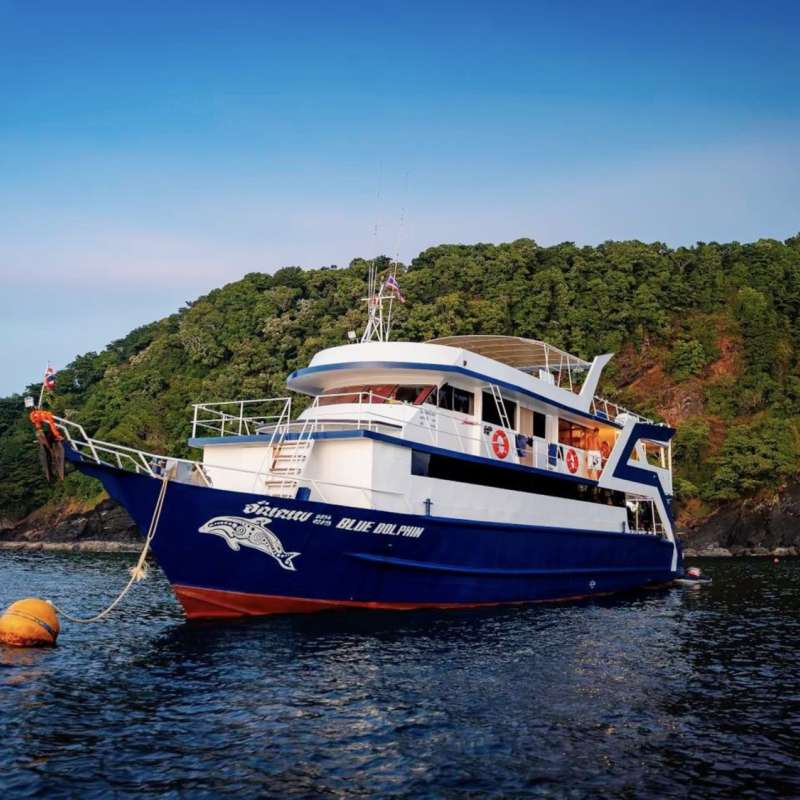
Thailand may be best known for its temples, street food, and pristine beaches, but beneath the warm turquoise waters of the Andaman Sea lies a diving destination that draws serious underwater explorers from around the world. Almost all of Thailand's best diving is concentrated along its western Andaman coastline, where a chain of protected island groups and submerged pinnacles deliver consistently excellent visibility, warm water year-round, and an impressive diversity of marine life from gentle whale sharks and manta rays to vibrant soft coral gardens and rare macro critters.
Thailand's two main liveaboard diving regions are distinct in character and each deserves its own season. To the north, the Similan Islands — anchored by the world-famous Richelieu Rock and the pristine reefs of the Similan and Surin National Parks — represent the pinnacle of Thailand's liveaboard diving and are open to visitors only between mid-October and mid-May. To the south, the South Andaman Sea offers a contrasting range of dive sites around Koh Phi Phi, Koh Lanta, and the legendary twin pinnacles of Hin Daeng and Hin Muang, and operates year-round from Phuket.
Together, the two regions ensure that there is always excellent liveaboard diving available somewhere in Thailand's waters, regardless of the season.
Why Dive Thailand by Liveaboard
Thailand's most celebrated dive sites have one thing in common: they are best experienced early in the morning, before the day-trip speedboats arrive. At Richelieu Rock — consistently ranked among the world's top ten dive sites — the whale sharks, seahorses, and manta rays that make the site extraordinary are most reliably present at first light, before the site becomes busy with day-trippers from the mainland. Being on a liveaboard means you are already anchored at the site overnight, ready to slip into the water at dawn when the conditions are at their best and the crowds are at their smallest.
The same logic applies throughout the Similan Islands National Park. Liveaboards have access to sites that day boats must reach after a long early-morning speedboat transfer from Khao Lak, arriving later and diving for a shorter window. A liveaboard typically completes three or four dives at the Similans before the day-trip fleet has finished their first. In the South Andaman Sea, liveaboards operating around Koh Phi Phi and Koh Lanta can anchor at Hin Daeng and Hin Muang — a 70-kilometre journey from Koh Lanta that makes day trips impractical — and dive these remote manta ray hotspots in near-total solitude.
For divers visiting Thailand, a liveaboard is the single most effective way to see the marine life that makes the Andaman Sea famous.
Thailand Liveaboard Quick Facts
All Thailand liveaboards depart from Phuket, which is served by direct international flights from across Asia, Europe, and Australia. Water temperature in the Andaman Sea ranges from 27°C to 30°C throughout the year, making a 3mm wetsuit comfortable for most divers. Visibility averages 20 to 30 metres at the Similan Islands during the peak season and 10 to 20 metres across most South Andaman Sea sites. Most Thailand liveaboards offer 3 to 4 dives per day, including night dives on most itineraries. Nitrox is available on the majority of vessels. Typical itinerary lengths range from 4 nights for a focused Similan trip to 7 or more nights for combined Thailand-Myanmar routes. No diving experience beyond Open Water certification is required for most Andaman Sea sites, though stronger current conditions at sites like Koh Tachai and Koh Bon benefit from Advanced Open Water certification.
Liveaboard Diving Regions in Thailand

Similan Islands and North Andaman Sea
The Similan Islands National Park — a chain of nine granite islands rising from the Andaman Sea approximately 70 kilometres northwest of Khao Lak — is Thailand's most iconic liveaboard diving destination, and one of the finest in all of Southeast Asia. The islands' western sides are swept by open-ocean currents that bring cold, nutrient-rich water to the surface, creating the conditions that support an extraordinary density of marine life. The eastern sides, sheltered from the prevailing swell, offer gentle, clear-water reef diving on pristine hard coral gardens with visibility that regularly reaches 25 to 30 metres throughout the season.
The standard Similan liveaboard itinerary of four to six nights also typically includes Koh Bon and Koh Tachai — two remote seamounts north of the main island chain that are among the most reliable manta ray aggregation sites in Thailand — and the crown jewel of the entire region: Richelieu Rock. Located near the Surin Islands close to the Myanmar border, Richelieu Rock is a horseshoe-shaped limestone pinnacle rising from the seabed at 35 metres. Its complex structure harbours an extraordinary concentration of marine life: wobbegong sharks, ghost pipefish, frogfish, mantis shrimp, and seahorses in the crevices, while the open water around the pinnacle regularly produces whale shark encounters and large pelagic aggregations. It is not an exaggeration to say that for many divers, a dive at Richelieu Rock is the highlight of an entire Thailand trip.
Longer itineraries of seven nights or more extend the route northward across the Myanmar border into the Burma Banks — a series of submerged seamounts in Myanmar's Mergui Archipelago, famous for their populations of silver-tip sharks and bull sharks at depth. These combined Thailand-Myanmar routes offer some of the most complete big-animal diving available in this part of the world.
The Similan and Surin National Parks are closed to all visitors from mid-May to mid-October each year due to the southwest monsoon. Best season: mid-October to mid-May.
South Andaman Sea
The South Andaman Sea — the waters south of Phuket encompassing the dive sites around Koh Phi Phi, Koh Lanta, Koh Ha, and the twin pinnacles of Hin Daeng and Hin Muang — offers a different but equally compelling liveaboard experience, and has the significant advantage of being accessible year-round. While conditions are at their peak from October to May, the South Andaman can be dived in calmer months when the northern parks are closed, making it the backbone of Thailand's off-season liveaboard calendar.
The region's signature dive sites vary dramatically in character. Around Koh Phi Phi, divers encounter Shark Point (Hin Musang) — a series of granite pinnacles smothered in colourful soft corals and home to leopard sharks resting on the sandy bottom, as well as blue-spotted stingrays, moray eels, and dense schools of reef fish. Nearby Bida Nok and Bida Nai offer beautiful wall and slope diving with excellent fish diversity. The King Cruiser wreck, a car ferry that sank in 1997 between Phuket and Phi Phi, is now one of Thailand's most popular wreck dives, encrusted in soft corals and inhabited by a thriving community of lionfish, grouper, and batfish.
Further south, the twin pinnacles of Hin Daeng (Red Rock) and Hin Muang (Purple Rock) — located approximately 70 kilometres southwest of Koh Lanta — represent the undisputed highlight of the South Andaman Sea for experienced divers. Hin Daeng's walls are draped in the brilliant red soft corals that give the site its name, dropping steeply to depths beyond recreational limits. Hin Muang, the less-visited of the two, plunges even deeper and is regarded as one of Thailand's deepest and most dramatic dive sites. Both pinnacles are well-known aggregation points for oceanic manta rays, particularly from January to April, and whale shark encounters are regularly reported here throughout the season. Best season: October to May for optimal conditions; year-round operation available.
How to Choose Your Thailand Liveaboard Route
Choosing between the North and South Andaman Sea comes down largely to the time of year you are visiting and the specific experiences you are prioritising.
If you are visiting between mid-October and mid-May and have not yet dived the Similan Islands or Richelieu Rock, a Similan-focused itinerary of four to six nights is almost certainly the right choice. These are Thailand's most celebrated dive sites and should be the foundation of any first Thailand liveaboard trip. A five-night Similan itinerary typically covers the main island group, Koh Bon, Koh Tachai, and Richelieu Rock — a combination that delivers the full range of Thailand's signature marine life experiences.
If you are visiting during the monsoon months from May to October, or if you have already dived the Similans and are returning to Thailand for a different experience, the South Andaman Sea offers rewarding year-round liveaboard diving with excellent manta ray encounters at Hin Daeng and Hin Muang, outstanding soft coral scenery, and the added variety of the King Cruiser wreck.
If you have seven nights or more and want the most complete Andaman Sea experience available, consider a combined Thailand and Myanmar itinerary that extends north into the Burma Banks — covering the Similans, Surin Islands, Richelieu Rock, and the shark seamounts of Myanmar's Mergui Archipelago in a single journey. These extended routes are offered by several liveaboards operating from Phuket during the northern season.
Contact our dive travel specialists for personalised Thailand liveaboard advice
Frequently Asked Questions
When is the best time for a Thailand liveaboard?
Mid-October to mid-May is the main Andaman diving season, and the window during which the Similan and Surin National Parks are open. Within this season, December to April offers the most reliable weather and visibility. The South Andaman Sea around Koh Phi Phi and Koh Lanta operates year-round, making it the only liveaboard option during the monsoon months of June to October.
Why are the Similan Islands closed for part of the year?
The Royal Thai government closes the Similan and Surin National Parks to all visitors from 16 May to 14 October each year to protect the marine environment during the southwest monsoon season. During this period, seas are often rough and unsafe, and the closure allows the reefs to recover from the impact of the diving season. Liveaboards operating in this period switch to South Andaman Sea routes instead.
What is Richelieu Rock, and why is it so famous?
Richelieu Rock is a submerged limestone pinnacle located near the Surin Islands, close to the Thai-Myanmar maritime border. It is consistently ranked among the world's top ten dive sites for its extraordinary concentration of marine life, which includes whale sharks, manta rays, seahorses, ghost pipefish, frogfish, and large schools of pelagic fish. It can only be reached on a liveaboard that includes the northern Similan Islands route, as it is too remote for day-trip access.
Are whale sharks common in Thailand?
Whale shark sightings are most frequent at Richelieu Rock and at Hin Daeng and Hin Muang in the South Andaman Sea. While sightings are never guaranteed, Thailand's Andaman Sea is one of the more reliable locations in Southeast Asia for whale shark encounters, particularly between November and April.
What experience level is required for Thailand liveaboard diving?
Most Andaman Sea dive sites are accessible to Open Water certified divers. The Similan Islands, in particular, offer a wide range of sites suitable for all levels. Some sites — including Koh Tachai Pinnacle and Koh Bon — involve stronger currents that benefit from Advanced Open Water certification and previous drift diving experience. Dive guides on all liveaboards will assess conditions and adapt the diving to suit the group.
Part of Asia · Browse all Thailand liveaboards