Mexico is one of the most diverse and thrilling diving destinations on the planet — a country of two coastlines, each offering a fundamentally different underwater world, and together delivering some of the most extraordinary marine encounters available anywhere in the world.
On the Pacific side, the remote volcanic islands and sheltered bays of Baja California Sur host four of the most bucket-list-worthy dive experiences in existence. Socorro — often called the Galápagos of Mexico — delivers intimate encounters with giant manta rays, schooling hammerheads, dolphins, and seasonal humpback whales in one of the most pristine and pelagic-rich marine parks on earth. Guadalupe Island is the undisputed world capital of great white shark cage diving, where the exceptional visibility of the eastern Pacific allows face-to-face encounters with these apex predators in conditions found nowhere else. The Sea of Cortez — Jacques Cousteau's "aquarium of the world" — teems with sea lions, whale sharks, mobula rays, and blue whales along a biologically extraordinary inland sea. And Magdalena Bay, on the Pacific coast of Baja, hosts the second largest sardine run in the world alongside gray whale calving in its sheltered lagoons.
On the Caribbean side, the white-sand cenotes and underground river systems of the Yucatán Peninsula offer a category of diving completely unlike anything found in the open ocean — a surreal freshwater world of stalactites, haloclines, and crystal-clear passages that has made this region famous among cave and cavern divers worldwide.
Between the Pacific's pelagic giants and the Caribbean's subterranean wonders, Mexico rewards divers of every level and ambition.
Why Dive Mexico by Liveaboard
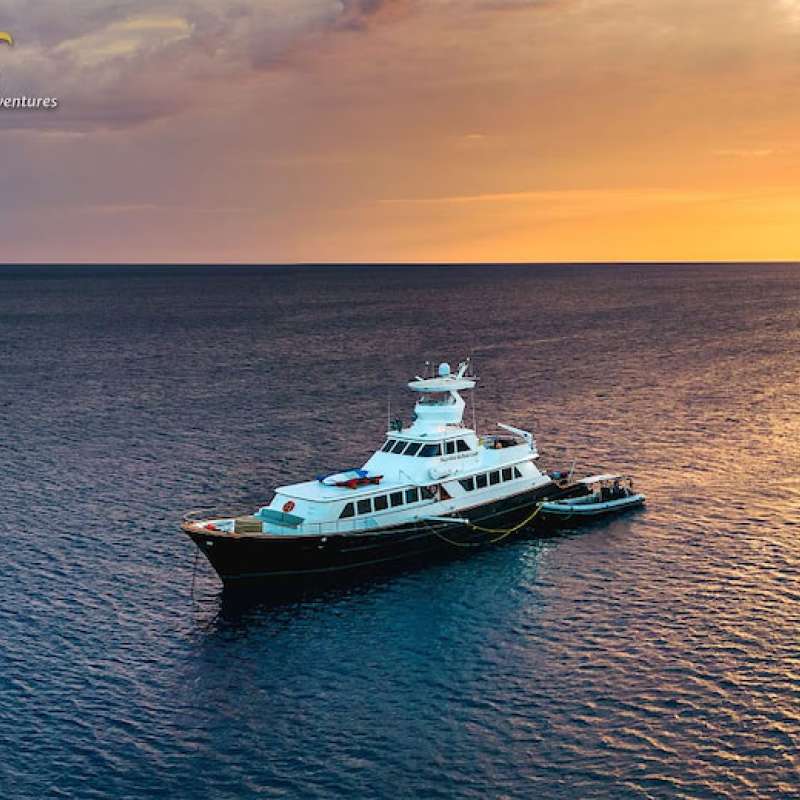
On Mexico's Pacific coast, a liveaboard is not simply the preferred way to dive — it is the only way to reach the sites that matter most. Socorro lies 250 nautical miles south of Cabo San Lucas, requiring a full day's offshore passage in each direction. Guadalupe Island sits 165 miles west of Baja California in the open Pacific. Neither destination has accommodation, infrastructure, or day-trip access of any kind. A liveaboard is the sole means of getting there, and the multi-day format it provides is exactly what these destinations reward: multiple dives per day across a full week. What's more, the cruise takes at least 24 to 30 hours to get there, so a liveaboard trip is the only option.
At Socorro specifically, the animal encounters that the islands are famous for — mantas approaching within touching distance, dolphins initiating extended free-swimming interactions, whale sharks cruising the shallower seamount areas — are behaviours that develop over the course of a dive, and often over the course of a trip. Divers who spend four or five days at the islands consistently report encounters that become more intimate and prolonged as the animals become familiar with the liveaboard's presence. A single-day visit would miss this entirely.
In the Sea of Cortez, a liveaboard allows itineraries that move between the inland sea's diverse zones — from the sea lion colonies of Los Islotes to the hammerhead seamounts of El Bajo to the sheltered bays where schools of mobula rays leap from the surface — covering in a week what would take a month of land-based day trips to approach.
Liveaboard Diving Regions :

Mexico's Pacific liveaboard destinations each have a distinct character, optimal season, and signature encounter. All depart from ports along the Baja California coast, with Los Cabos (San José del Cabo International Airport, SJD) serving as the primary hub for Socorro and Sea of Cortez routes, and Ensenada or San Diego for Guadalupe.
Socorro (Revillagigedo Islands)
Socorro Island is the centrepiece of Mexico's Revillagigedo Archipelago — a UNESCO World Heritage Site and Mexico's largest marine protected area, consisting of four volcanic islands rising from the deep Pacific roughly 250 nautical miles south of Cabo San Lucas. It is widely regarded as the finest big-animal diving destination in the eastern Pacific, and among the top liveaboard experiences in the world.
The islands' signature encounters are built around giant oceanic manta rays — both the reef manta and the larger oceanic manta species are present — which approach divers with a curiosity and confidence rarely seen elsewhere. Encounters at cleaning stations and open-water hovering sites allow prolonged, intimate interactions as mantas circle, investigate, and linger in ways that make Socorro unique among manta destinations globally. Ten species of shark inhabit or visit the archipelago regularly, including hammerheads schooling over seamounts, Galápagos sharks patrolling the walls, tiger sharks in the shallows, and silvertip and whitetip reef sharks on most dives. From January to April, humpback whale song resonates through the water column, and encounters with whales both above and below the surface are a consistent highlight of the season's peak months. Whale sharks move through the archipelago from April to June, adding another dimension to an already extraordinary species list.
The diving is primarily for experienced divers — currents are strong at some sites, crossings can be rough, and the open-ocean conditions demand calm, controlled diving. The rewards, however, are in proportion to the commitment. Best season: November to May.
Sea of Cortez
The Sea of Cortez — the narrow inland sea separating the Baja California Peninsula from mainland Mexico — was described by Jacques Cousteau as "the aquarium of the world", and that assessment has lost none of its accuracy. The sea is home to over 850 marine species and sits at the convergence of warm tropical currents and cold, nutrient-rich Pacific upwellings, creating a marine environment of exceptional biological productivity across every level of the food chain.
Sea of Cortez liveaboard itineraries operate out of La Paz and cover a circuit of the sea's most celebrated sites. Los Islotes — a rocky islet at the northern end of Espíritu Santo Island — hosts a permanent colony of playful California sea lions whose juveniles actively seek out divers, darting in and out of visibility, blowing bubbles, and performing acrobatic displays that make every dive joyful regardless of anything else encountered. El Bajo Seamount rises from 400 metres to within 25 metres of the surface and is one of the Sea of Cortez's most productive pelagic sites, with large schools of scalloped hammerhead sharks aggregating here from August to November — one of the most reliable hammerhead encounters in the entire Pacific. Whale sharks move through the sea from September to November, drawing alongside divers and snorkellers in warm, calm conditions that make these encounters among the most accessible in the world. Blue whales, fin whales, humpbacks, orcas, and sperm whales are all recorded in Sea of Cortez waters across different months, making it one of the richest whale-watching environments on the planet.
Unlike Socorro and Guadalupe, the Sea of Cortez is sheltered from the open Pacific swell, making conditions significantly calmer and the itinerary more accessible to less experienced divers and non-diving passengers. Best season: August to November.
Magdalena Bay
Magdalena Bay, on the Pacific coast of Baja California Sur, is Mexico's most seasonal and most dramatic liveaboard destination — a remote, wild coastline that hosts two of the ocean's most spectacular wildlife events at opposite ends of the calendar, drawing divers, photographers, and wildlife enthusiasts who understand that the best experiences in the ocean are often timed to the rhythms of migration and reproduction.
From mid-October to December, Magdalena Bay is the setting for the Mexican Sardine Run — the second largest sardine run in the world. Vast aggregations of sardines are corralled by the bay's geography and preyed upon simultaneously by striped marlin hunting at high speed, mako sharks, California sea lions, bottlenose dolphins, and multiple species of whale, all converging on the bait balls from different directions. From above, thousands of seabirds dive-bomb the surface. From below, the spectacle of an active predator event on this scale is among the most dramatic and unpredictable wildlife encounters available anywhere in the ocean — particularly for underwater photographers who want action rather than static encounters. For free divers and breath-hold snorkellers as well as scuba divers, the shallow, close-to-shore nature of many bait ball events makes Magdalena Bay accessible in ways that deep-ocean sardine runs are not.
From January to April, the bay transforms into one of the world's great gray whale calving and nursery grounds. California gray whales arrive to give birth and raise their calves in the sheltered lagoons, and the famous "friendlies" — mother gray whales who actively approach small boats and appear to present their calves for human interaction — have made Magdalena Bay one of the most profoundly moving wildlife experiences available anywhere. Liveaboard itineraries during this season combine whale encounters with diving on the bay's productive reef systems. Best season: October to December for the sardine run; January to April for gray whales.
Guadalupe Island
A remote volcanic island 165 miles west of Baja California in the eastern Pacific, is the world's premier destination for great white shark cage diving — a statement that, given the extraordinary visibility of Guadalupe's waters, is not hyperbole. In most great white shark destinations around the world, divers encounter these animals through murky green water from the surface. At Guadalupe, the visibility regularly exceeds 30 metres in water so clear and blue that photographs taken here have redefined the world's visual understanding of what great white shark diving can look like.
Unfortunately, Since January 2023, the Mexican government has shut down Guadalupe to all tourisim. For more information, you can read : Isla Guadalupe remains closed.
How to Choose Your Mexico Liveaboard Route
Mexico's four Pacific liveaboard regions each serve a different diver profile, and the right choice depends on what you most want to experience and when you can travel.
Divers whose primary goal is an intimate, sustained encounter with large pelagics — manta rays in particular — should prioritise Socorro. No other destination in the eastern Pacific delivers the quality and duration of manta encounters that the Revillagigedo Islands produce, and the full species list across a typical seven-night itinerary is extraordinary. Socorro requires Advanced Open Water certification and comfort in open-ocean conditions, and should be considered an aspirational destination for divers who are ready to take their liveaboard experience to a higher level.
Divers looking for the broadest possible range of marine wildlife in a relatively accessible environment should consider the Sea of Cortez — sea lions, hammerheads, whale sharks, whales, mobula rays, and diverse reef life in a sheltered sea that suits all experience levels. Combined Socorro and Sea of Cortez itineraries are available for divers who want to cover both in a single extended trip.
Divers and wildlife enthusiasts who want a seasonal event — the sardine run or the gray whale calving — should plan their visit to Magdalena Bay around the specific window that matches their target encounter, accepting that it is a weather-dependent and dynamic experience rather than a guaranteed one, and that the unpredictability is precisely what makes it so extraordinary.
Contact our liveaboard diving specialists for personalised liveaboard advice
Beyond the Liveaboard: Cenote Diving in the Yucatán Peninsula
Mexico's Pacific liveaboard regions are the country's headline diving destinations for serious underwater explorers — but on the opposite coast, the Caribbean side of the Yucatán Peninsula offers a category of diving experience that is utterly unlike anything found in the open ocean, and which completes the picture of Mexico as one of the world's most diverse diving nations.
The Yucatán Peninsula sits atop the world's most extensive underwater cave system — a network of flooded limestone passages, caverns, and rivers stretching for hundreds of kilometres beneath the jungle floor, fed by rainfall filtering through the porous rock and flowing toward the Caribbean Sea. Where the ceiling of these passages has collapsed, natural openings called cenotes (from the Mayan dz'onot, meaning "sacred well") appear at the surface — portals into an underground world of extraordinary stillness and beauty. There are an estimated 6,000 to 10,000 cenotes across the Yucatán, and the most spectacular are concentrated in and around Playa del Carmen and Tulum, within easy reach of Cancún International Airport.
Diving in the cenotes is unlike any ocean diving experience. The freshwater is crystalline — visibility can extend 100 metres or more in some systems — and the submerged geology creates a landscape of stalactites, stalagmites, and limestone formations that took tens of thousands of years to develop and were only exposed to air during the last ice age when sea levels were dramatically lower. At the boundary between freshwater flowing from the jungle and saltwater pushing in from the sea, a halocline creates an optical distortion effect — a shimmering, lens-like layer where the two waters meet — that produces some of the most surreal visual conditions available anywhere in the diving world. In certain passages, shafts of sunlight penetrate from the surface to illuminate the formations below in beams of extraordinary clarity, creating scenes that have become iconic in underwater photography.
The cenotes around Playa del Carmen and Tulum cater to every experience level. Cavern diving — conducted within 40 metres of a natural light source and requiring no additional training beyond Open Water certification — allows recreational divers to enter the most photogenic and accessible sections of the systems. The famous cenotes of Dos Ojos, The Pit, Chac Mool, and Calavera are among the most beautiful and most dived in the world, and can be experienced on guided cavern dives without specialist cave certification.
For certified cave divers — or divers who wish to train for full cave certification — the Yucatán is the single most important cave diving destination on earth, with systems including Sac Actun and Ox Bel Ha stretching for well over 200 kilometres of surveyed underwater passage. Cave diving courses at PADI and IANTD-certified dive centres in Playa del Carmen and Tulum are among the most highly regarded in the world.
At Dive and Cruise, we offer land-based cenote diving packages in Playa del Carmen and/or Tulum to complement our Pacific liveaboard programmes — allowing divers to extend their Mexico trip with a completely different underwater experience on the Caribbean coast. Whether you are joining a Socorro liveaboard out of Cabo San Lucas and want to add cenote diving days before or after your Pacific itinerary, or you are visiting the cenotes as a standalone experience, our team can arrange guided cavern dives, multi-cenote day trips, and accommodation to match your schedule. Contact us for details.
Frequently Asked Questions
What is the best time of year for a Mexico liveaboard?
The best time depends entirely on which region you are visiting. Socorro is best from November to May, with peak humpback whale activity from January to April and whale shark encounters from April to June. The Sea of Cortez can be dive all year round depends on the route. Magdalena Bay's sardine run occurs from October to December, and the gray whale calving season runs from January to April. Cenote diving on the Caribbean coast is excellent year-round, with no meaningful seasonal variation in the underground river systems.
Do I need to be an experienced diver to join a Mexico liveaboard?
Experience requirements vary significantly by destination. Socorro requires Advanced Open Water certification and significant experience with open-ocean conditions and strong currents — it is not suitable as a first liveaboard experience. The Sea of Cortez is accessible to Open Water certified divers and is designed to accommodate less experienced divers and even non-divers on some itineraries. Magdalena Bay is suitable for all levels. Cenote cavern diving in the Yucatán requires Open Water certification.
Can I combine a Pacific liveaboard with cenote diving in the same Mexico trip?
Yes, though the two coastlines are geographically separated — the Pacific ports (Los Cabos, Ensenada) are on the opposite side of the country from Playa del Carmen and Tulum on the Caribbean coast. A combined trip is entirely practical with a domestic flight connecting the two coasts, and many of our divers choose to extend their Mexico visit to experience both the pelagic diving of the Pacific and the underground river systems of the Yucatán in a single journey. Our team at Dive and Cruise can arrange both the Pacific liveaboard and the Yucatán cenote package as part of a joined itinerary — contact us to discuss.
What makes Socorro different from other manta ray destinations?
Socorro's mantas are notable for their behaviour rather than simply their numbers. The giant oceanic mantas at the Revillagigedo Islands approach divers with an active curiosity — circling, hovering, and returning for extended inspections — that is attributed to decades of respectful interaction with liveaboard diving operations. In most manta destinations, encounters are opportunistic and brief. At Socorro, it is routine for a single manta encounter to last 20 to 30 minutes, with the animal repeatedly returning to the same group of divers. This quality of interaction is unique in the world.
What wetsuit do I need for Mexico liveaboards?
Wetsuit requirements vary dramatically by destination. Socorro's water temperature ranges from 21°C to 28°C depending on the month — a 5mm full wetsuit is recommended for the cooler months of January and February, while 3mm is sufficient in November and May. The Sea of Cortez range from a low of 21°C in the winter months, to a high of 26°C in the late fall and spring months. But strong current fluctuations mean that there can be cooler water below. Cenote diving in the Yucatán is in freshwater averaging 24°C to 25°C year-round — a 3mm wetsuit or even a skin suit is adequate for most divers.
Part of Americas & Caribbean · Browse all Mexico liveaboards