Jacques Cousteau called Fiji the Soft Coral Capital of the World, and the title has stuck for good reason. This South Pacific archipelago of more than 330 islands sits at the intersection of warm equatorial currents and deep ocean upwellings, creating the conditions for reef life of extraordinary colour, density, and variety. Soft corals in every shade of red, orange, purple, and yellow carpet the walls and pinnacles of Fiji's best dive sites — particularly when strong currents run and the colonies open fully, transforming entire sections of reef into what many divers describe as the most visually overwhelming underwater scenery they have ever witnessed.
But soft corals are only the opening act. Fiji is also one of the finest shark diving destinations in the South Pacific, with bull sharks, tiger sharks, and up to eight species of reef and pelagic shark reliably encountered in Beqa Lagoon. Hammerheads school over seamounts in Bligh Water. Manta rays feed at cleaning stations in the Yasawa Islands and Kadavu. Humpback whales pass through between July and October. The Namena Marine Reserve — one of Fiji's oldest and most protected marine parks — delivers pristine walls, bommies, and reef systems that reward both wide-angle photographers and macro hunters equally.
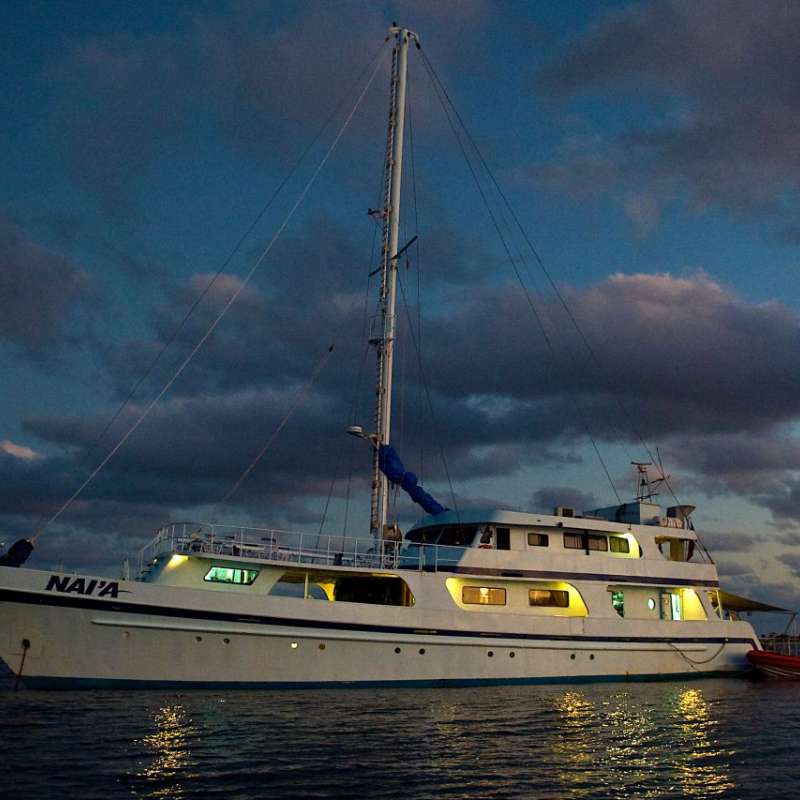
Fiji's best dive sites are spread across a vast archipelago, and a liveaboard is the only practical way to reach the remote areas — Bligh Water, Namena, Wakaya, Gau, and Kadavu — that define the destination at its finest.
Why Dive Fiji by Liveaboard
Many of Fiji's most celebrated dive sites are simply out of reach for land-based operations. Bligh Water, Namena Marine Reserve, Wakaya Island, and the remote reefs of Gau Island in the Koro Sea require overnight passages that make day-trip diving not just inconvenient but impossible. A liveaboard connects these locations into a single itinerary, allowing a week at sea to cover the full geographic spread of Fiji's underwater world — from the shark-filled lagoon of Beqa near the main island of Viti Levu to the pristine, rarely visited walls of the outer islands.
The current-swept nature of Fiji's best dive sites is another reason liveaboard timing is so valuable. Sites like Nigali Passage on Gau Island and the channels of Namena Marine Reserve dive best on the right tidal window — a narrow period of incoming or outgoing flow when the currents concentrate fish life and sharks in the passage in extraordinary numbers. A liveaboard can position itself to hit these windows precisely, arriving at the site and entering the water at the optimal moment rather than working around a fixed departure schedule from shore. The difference between diving Nigali Passage at the right moment and the wrong one is the difference between 50 sharks and five.
For Fiji specifically, a liveaboard also unlocks the Bligh Water region — named after the famous mutiny voyage of William Bligh, who navigated these waters in an open boat in 1789 — which is widely regarded as the finest concentration of soft coral diving in the entire country, and is accessible only to vessels that can make the overnight crossing from Viti Levu.
Diving Style in Fiji
Fiji offers a genuinely broad range of diving styles, which is one of its most appealing qualities for mixed-experience groups and returning divers who want variety across a single trip.
Drift diving through tidal passages is the signature Fiji experience — channels between islands funnel current-driven water in and out with each tidal cycle, and timing a drift through Nigali Passage or Namena's North Save-A-Tack Passage at peak flow delivers an exhilarating, fast-moving dive through clouds of fish, circling sharks, and brilliantly coloured soft coral walls. These dives require drift diving experience and comfort in strong, variable currents.
Wall diving is equally prominent, particularly in Bligh Water and around the outer islands. Walls begin just below the surface and drop to beyond 300 metres in some locations, with soft coral coverage that peaks during the dry season when stronger currents open the colonies fully.
Macro diving and reef exploration are best in the calmer lagoon areas — Beqa Lagoon, sections of Namena Marine Reserve, and sites around the Yasawa Islands provide sheltered, current-free environments ideal for nudibranchs, ghost pipefish, pygmy seahorses, and the reef fish diversity that fills Fiji's protected reefs. Beqa Lagoon specifically is the setting for one of the South Pacific's most iconic shark experiences, conducted from a fixed position on the sandy bottom in water of around 30 metres.
Liveaboard Dive Areas in Fiji
Bligh Water : between the main islands of Viti Levu and Vanua Levu, is the epicentre of Fiji's soft coral reputation and the primary destination for most Fiji liveaboard itineraries. The channel's powerful currents feed a reef system of extraordinary richness — seamounts, walls, and bommies (isolated coral pinnacles) smothered in soft coral and patrolled by schooling barracuda, trevally, and reef sharks. The E-6 seamount, rising 900 metres from the sea floor, is one of the region's most celebrated dive sites, producing hammerhead encounters alongside huge gorgonian fans and dense macro life.
Namena Marine Reserve : off the coast of Vanua Levu, is one of Fiji's oldest protected marine areas and arguably its most diverse single dive region. North Save-A-Tack Passage delivers powerful drift dives past schooling fish and patrolling whitetip reef sharks. The southern bommies — known locally as Chimneys, Magic Mountain, and Fantasea — are encrusted in soft corals and teeming with macro life, including pygmy seahorses, nudibranchs, and cleaning stations of extraordinary activity. Access is strictly by liveaboard for the most productive sites.
Beqa Lagoon : south of Viti Levu, is home to the Shark Reef Marine Reserve — a protected area where up to eight species of shark can be encountered on a single dive, including bull sharks, tiger sharks, nurse sharks, grey reef sharks, whitetip reef sharks, tawny nurse sharks, blacktip reef sharks, and silvertip sharks. The dive is conducted as a structured feed dive from a fixed position on the sandy bottom at around 30 metres, ascending through successive depth zones as the species profile changes from the deepest, largest animals to the shallower reef sharks on the way up. It is one of the most meticulously managed shark dive operations in the world.
Gau Island and Nigali Passage : in the Koro Sea represent some of Fiji's most spectacular current diving. Nigali Passage channels tidal flow through a narrow coral canyon, concentrating grey reef sharks, barracuda, trevally, and reef fish in numbers that make it one of the finest passage dives in the Pacific. Grey reef sharks gather here in groups that regularly exceed 30 to 40 individuals on the right tide.
Taveuni and the Somosomo Strait : reachable on longer liveaboard itineraries — are home to the Rainbow Reef and the Great White Wall: a section of vertical reef where soft white corals create the appearance of a snow-covered cliff face, producing one of the most iconic wide-angle dive photographs in the South Pacific.
Kadavu and the Great Astrolabe Reef : the fourth-largest barrier reef in the world, offers wall and channel diving alongside one of Fiji's most reliable manta ray cleaning stations, where oceanic mantas regularly aggregate in the channel passages.
Best Time to Dive Fiji
Fiji can be dived year-round, but the dry season from May to October is widely considered the optimal window for liveaboard diving. During these months, seas are calmer, winds lighter, and visibility regularly reaches 25 to 30 metres on outer reefs and walls. Stronger currents during the dry season also trigger soft coral colonies to open fully — the reef life that defines Fiji's visual identity is at its most spectacular from approximately April to July, when nutrient-rich current flow is at its strongest and most consistent.
The dry season is also peak season for several of Fiji's most sought-after marine life encounters. Humpback whales pass through Fiji's waters between July and October, and while sightings are opportunistic rather than guaranteed, a liveaboard in these months offers the best possible chance of hearing their song underwater or encountering them at the surface between dives. Shark activity in Beqa Lagoon and Bligh Water is most consistent from June to September, when cooler, nutrient-rich water brings baitfish and their predators in greater numbers.
The wet season from November to April brings warmer water temperatures — rising to 28°C — and a shift in the marine life calendar. Manta ray sightings increase around the Yasawa Islands and Kadavu from November to May, drawn by plankton-rich channels. Macro life flourishes in the calmer lagoon areas, and coral spawning events — brief but spectacular mass reproduction events where the entire reef simultaneously releases clouds of eggs and sperm — occur during the warmer months. Visibility can be reduced near river mouths and in plankton-heavy water, but on outer reef sites it remains good throughout the wet season.
Marine Life by Season
From May to October, the dry season brings humpback whales through Fiji's offshore waters (July to October), peak soft coral display driven by strong currents (May to July), consistent shark activity in Beqa Lagoon and Bligh Water, and the best overall visibility across the archipelago. Hammerhead encounters at E-6 seamount in Bligh Water are most frequently reported during these months.
From November to April, manta ray season peaks in the Yasawa Islands and Kadavu (November to May), with the best manta cleaning station encounters reliably occurring during this period. Macro diversity flourishes in the lagoon areas — nudibranchs, ghost pipefish, ribbon eels, mantis shrimp, and leaf scorpionfish are most active in the warmer, calmer conditions. Coral spawning occurs in November and December. Water temperatures are at their warmest and most comfortable for longer dives.
Sharks, turtles, Napoleon wrasse, barracuda, trevally, and the soft coral reefs themselves are present and productive year-round across all major liveaboard regions.
Water Temperature and Visibility
Water temperature ranges from 24°C to 27°C during the dry season (May to October) and rises to 27°C to 29°C during the wet season (November to April). A 3mm wetsuit is comfortable for most divers throughout the year; some divers prefer a 5mm for extended multiple-dive days during the cooler dry season months.
Visibility in Fiji varies significantly by site and season. On outer reefs and walls during the dry season, 25 to 30 metres is typical, and conditions of 35 metres or more are possible at remote sites like Namena and the seamounts of Bligh Water. In the Beqa Lagoon and sheltered lagoon areas, visibility of 15 to 20 metres is standard. Plankton blooms driven by seasonal current shifts can reduce visibility to 10 metres in affected areas — a trade-off that is generally associated with increased marine life activity rather than reduced diving quality.
Diving Conditions
Fiji's diving spans a wide range of conditions, making it genuinely accessible to divers from Open Water level upwards — with some important distinctions between site types.
The sheltered lagoon sites of Beqa Lagoon, the Yasawa Islands, and sections of Namena Marine Reserve are suitable for Open Water certified divers with reasonable buoyancy control. The Beqa shark dive specifically requires no specific certification beyond Open Water, though comfort in 30-metre depths and around large, free-swimming animals is a reasonable prerequisite.
The passage and channel dives — Nigali Passage, North Save-A-Tack, and the channels of Bligh Water — involve currents ranging from moderate to strong, and require Advanced Open Water certification and previous drift diving experience. At peak tidal flow, currents in some passages can be powerful enough to require a reef hook to hold position. These are not dives to attempt without previous experience of current management.
The outer wall and seamount dives of Bligh Water and Namena reach depths of 30 to 40 metres and are best suited to Advanced Open Water certified divers. Nitrox is widely available on Fiji liveaboards and is recommended for maximising bottom time at the deeper sites. The Great White Wall at Taveuni requires an Advanced Open Water certification due to the depth of the entry point and the strong current conditions in the Somosomo Strait.
Fiji does not have the same logistical remoteness from decompression facilities as destinations like Malpelo or the Banda Sea — the main islands have medical facilities and recompression resources are available — but conservative dive profiles remain standard practice on all liveaboard operations.
Who Is Fiji For?
Fiji is one of the most genuinely versatile liveaboard destinations in the world — a rare destination where the answer to "who is it for" is genuinely broad.
Wide-angle photographers will find Fiji's soft coral reefs in full current flow — particularly in Bligh Water between May and July — among the most spectacular reef photography conditions available anywhere in the Pacific. The combination of colour, density, and the fish life that the currents concentrate creates images that are difficult to replicate elsewhere.
Shark divers who want a structured, high-quality, multi-species encounter in exceptional visibility will find the Beqa Lagoon shark dive one of the finest of its kind in the world — more diverse in species than most shark feed operations, more carefully managed, and conducted in clear water that makes photography straightforward.
Divers seeking marine life diversity rather than a single signature encounter will find Fiji extraordinarily rewarding — the combination of soft corals, sharks, mantas, hammerheads, humpback whales (seasonally), and outstanding macro life means that no two dives on a Fiji liveaboard feel remotely similar.
Less experienced divers will find genuine entry points into Fiji's underwater world in the sheltered lagoon areas, making it one of the few Pacific liveaboard destinations where Advanced Open Water certification is not a prerequisite for meaningful participation in the itinerary.
Browse Fiji liveaboards on Dive and Cruise
Frequently Asked Questions
Is Fiji suitable for beginner divers?
Yes — more so than most Pacific liveaboard destinations. Fiji's diversity of site types includes genuinely sheltered, low-current reef and lagoon diving alongside the more demanding passage and wall dives. Open Water certified divers can participate meaningfully in a Fiji liveaboard itinerary, though Advanced Open Water certification opens up the most productive and exciting sites. Dive guides on all Fiji liveaboards will assess conditions and adapt the programme to suit the group.
What makes Fiji's soft corals so special?
Fiji's soft corals — particularly the large, branching Dendronephthya and leather coral species found in current-swept areas — grow in extraordinary density and open fully when current flows, creating the curtain-of-colour effect that made Cousteau's description so enduring. The combination of warm water, strong currents delivering nutrients, and long-established protection in key areas like Namena Marine Reserve has allowed these colonies to develop to a scale and health that is genuinely exceptional by global standards.
Can I see both sharks and manta rays on the same Fiji liveaboard trip?
Yes — depending on the season and itinerary. Dry season itineraries (May to October) covering Bligh Water, Namena, and Beqa Lagoon deliver strong shark encounters throughout, with manta ray sightings most likely in the Yasawa Islands and Kadavu. Wet season itineraries (November to April) bring the highest manta ray activity. A longer 10-night itinerary covering multiple regions maximises the chance of encountering both.
When do humpback whales pass through Fiji?
Humpback whales migrate through Fiji's offshore waters between July and October, travelling from their Antarctic feeding grounds to tropical calving areas. Encounters are opportunistic — from the boat between dives or occasionally during a dive — rather than planned wildlife experiences. Fiji is a protected whale sanctuary, and there are no commercial swim-with-whales operations; all encounters are completely wild.
Do I need nitrox certification for Fiji liveaboard diving?
Nitrox certification is not mandatory but is strongly recommended for maximising bottom time at Fiji's deeper sites, including the seamounts of Bligh Water and the walls of Namena Marine Reserve. Most Fiji liveaboards offer nitrox as standard or for a small supplement, and onboard nitrox certification is often available for divers who wish to qualify during their trip.
Part of Pacific & Oceania · Browse all Fiji liveaboards